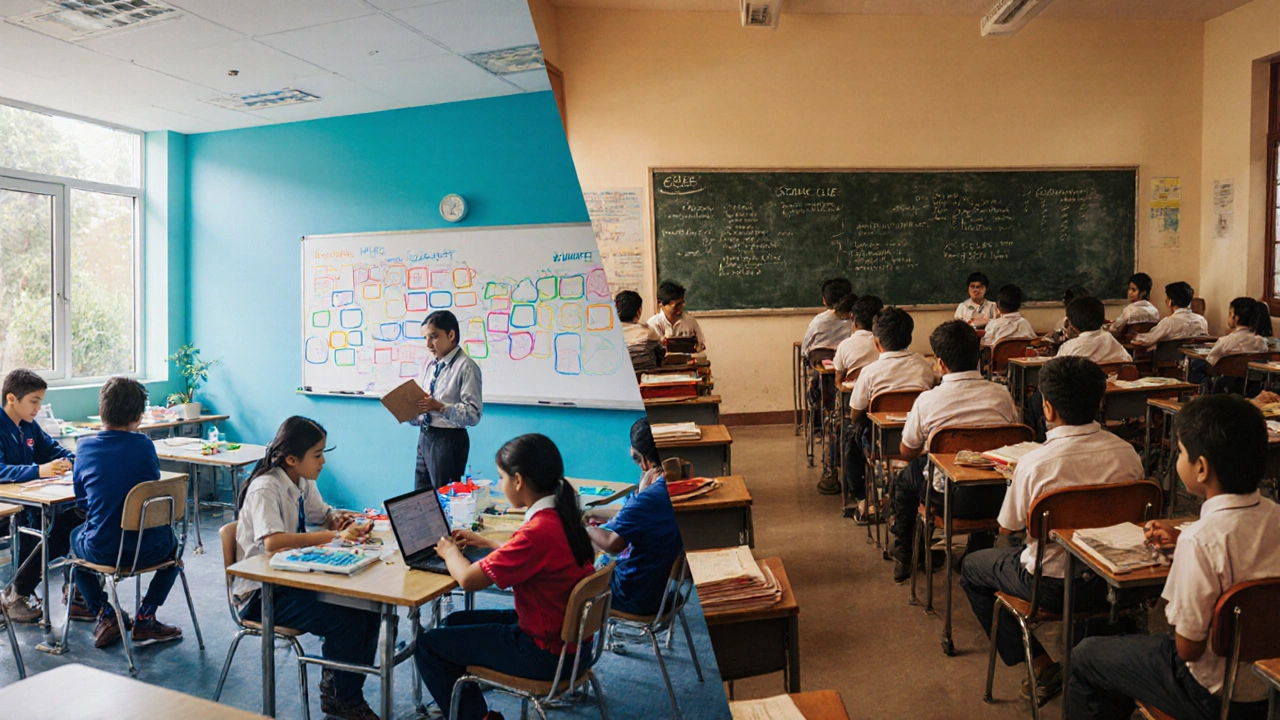
Education Comparison: How India’s Systems Stack Up Against the World
When you think about education comparison, the process of evaluating how different school systems, curriculums, and teaching methods perform across countries and boards. Also known as academic system analysis, it’s not about which one is better—it’s about which one fits your goals. In India, parents and students face a real choice: CBSE, ICSE, state boards, or even international curriculums like IB or Cambridge. Each has different strengths, and the right one depends on whether you’re aiming for IIT JEE, NEET, or studying abroad.
Take CBSE, the Central Board of Secondary Education, India’s most widely followed board, designed for national exam readiness and mobility across states. It’s structured, exam-focused, and aligns directly with competitive exams like JEE and NEET. That’s why over 20,000 CBSE schools exist across India and even in 25+ countries. Compare that to ICSE, the Indian Certificate of Secondary Education, which emphasizes depth, language skills, and project-based learning over rote memorization. ICSE students often perform better in English and humanities, but the syllabus is heavier and less aligned with engineering entrance patterns.
On a global scale, countries like Singapore and Finland lead in real-world math and problem-solving, according to PISA data, while China dominates math Olympiads. But here’s the thing: no single system is perfect. Singapore’s system is rigid and high-pressure. Finland’s is relaxed but doesn’t produce as many top scorers in international contests. India’s CBSE strikes a middle ground—efficient for exams, scalable, and practical for students aiming for top engineering or medical colleges. Meanwhile, international boards like IB focus on critical thinking and global perspectives, but they’re expensive and not always useful if you plan to stay in India for higher education.
What you’re really comparing isn’t just syllabi—it’s outcomes. Do you want your child to ace JEE in 12th grade? CBSE is the shortcut. Do you want them to write essays, think critically, and handle open-ended questions? ICSE or IB might be better. Are you planning to study abroad? Then the IB or Cambridge A-Levels give you a direct path. And if you’re preparing for UPSC or government jobs later, the clarity and structure of CBSE helps build the discipline you’ll need.
There’s no magic formula. But if you look at the data—from PISA scores to IIT topper lists to global university admissions—you start seeing patterns. The best education comparison isn’t about labels. It’s about matching your child’s strengths, your family’s goals, and the career path ahead. Below, you’ll find real breakdowns of what works, what doesn’t, and who wins where—backed by actual results, not opinions.