Learning Platform Selector
Answer three questions to find your ideal platform.
Recommended Platform
Coursera
Description goes here.
Why it fits:
- Reason 1
- Reason 2
Subscription
Professionals
Select your options and click "Find My Platform" to see our recommendation.
There isn't one single "most used" learning platform. The answer depends entirely on who you are. If you are a student looking for university credits, the leader is different than if you are a corporation training ten thousand employees.
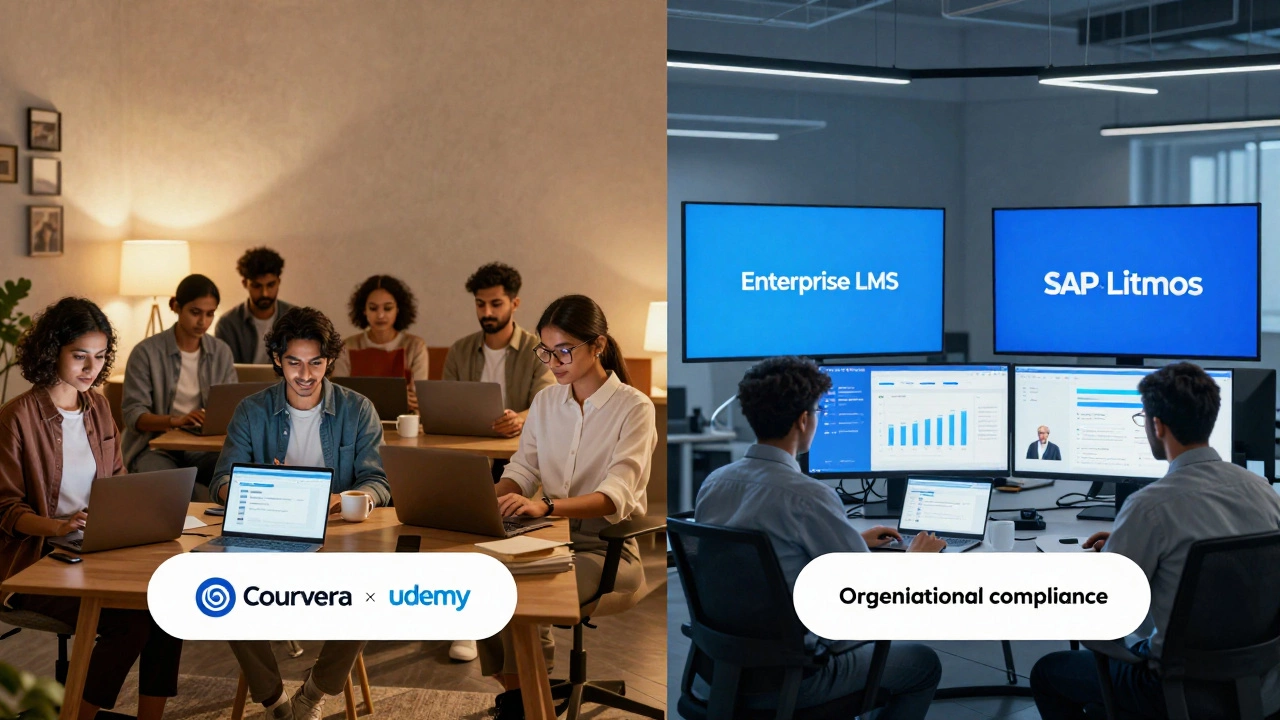
In 2026, the landscape is split into two massive camps: **Massive Open Online Courses (MOOCs)** for individuals and **Learning Management Systems (LMS)** for organizations. Understanding this distinction is the only way to find the right tool for your needs.
The Individual Learner Market: MOOC Giants
For people seeking self-paced education, skill upgrades, or academic certificates, the battle for dominance is fierce. When we talk about raw user numbers and global recognition, three names consistently sit at the top of the heap.
If your goal is to add a recognized credential to your LinkedIn profile or resume, Coursera is often the default choice. Their "Specializations" allow users to take a series of courses to master a subject, culminating in a certificate. While many courses are free to audit, the certificates require payment, which drives their revenue model.
Udemy’s strength lies in its affordability and depth. Frequent sales drop course prices to $10-$15, making it accessible for hobbyists and beginners. However, the quality varies wildly because there is no central curriculum standard. You have to read reviews carefully to avoid low-effort content.
The Corporate Market: Enterprise LMS Leaders
When companies need to train staff on compliance, safety, or new software, they don’t use Coursera. They use dedicated Learning Management Systems. These platforms track progress, generate reports, and integrate with HR tools. In this sector, "most used" refers to market share among businesses.
Another major player is Totara Learn, which is open-source based but highly customizable. Companies that need specific branding or complex reporting structures often choose Totara. Then there is Docebo, known for its AI-driven recommendations and sleek interface, appealing to mid-sized tech-forward companies.
For small businesses and solo coaches, LearnDash (a WordPress plugin) and Kajabi dominate. These aren't just LMS; they are all-in-one marketing and course hosting solutions. If you see a local business selling an online workshop, chances are it's hosted on one of these platforms.

Comparison: Which Platform Fits Your Goal?
To help you decide, let's look at how these platforms compare across key attributes. This table breaks down the primary focus, cost structure, and best use case for each major entity.
| Platform | Type | Primary Audience | Cost Model | Best For |
|---|---|---|---|---|
| Coursera | MOOC | Professionals, Students | Subscription / Per Course | Academic Certificates & Career Switching |
| Udemy | Marketplace | Hobbyists, Developers | Pay-Per-Course (often discounted) | Specific Technical Skills & Hobbies |
| edX | Non-Profit MOOC | Academics, Researchers | Audit Free / Verified Fee | University-Level Rigor |
| SAP Litmos | Enterprise LMS | Large Corporations | Enterprise Licensing | Compliance & Global Training |
| Kajabi | All-in-One SaaS | Coaches, Creators | Monthly Subscription | Selling Courses & Marketing |
Why "Most Used" Can Be Misleading
When searching for the "most used" platform, you might encounter conflicting data. This happens because metrics differ. Coursera might have more *registered* users, but Udemy might have more *active* monthly learners due to its lower price point. Meanwhile, SAP Litmos might serve fewer total humans but generates more revenue per user through enterprise contracts.
Furthermore, niche platforms are growing rapidly. For coding specifically, **Codecademy** and **freeCodeCamp** are dominant forces that general-purpose platforms cannot match in interactivity. For language learning, **Duolingo** dwarfs every other educational app in daily active users, though it is often categorized separately from traditional "learning platforms."

How to Choose the Right Platform for You
Don't just pick the biggest name. Ask yourself three questions:
- What is my end goal? Do you need a piece of paper (certificate) for your boss, or do you need to know how to fix a sink? If it's the former, go with Coursera or edX. If it's the latter, Udemy or YouTube tutorials are better.
- What is my budget? Coursera subscriptions can run $39-$49/month. Udemy courses are often under $20. FreeCodeCamp is completely free. Align the cost with the expected return on investment.
- Do I need community support? Some platforms offer peer-reviewed assignments and discussion forums (Coursera). Others are solitary experiences (Udemy video libraries). If you struggle with self-discipline, look for platforms with cohort-based elements or strong community features.
The Future of Learning Platforms in 2026 and Beyond
The industry is shifting towards micro-credentials and AI personalization. Platforms are no longer just repositories of videos. They are using artificial intelligence to adapt content to your learning speed. For example, if you fail a quiz question on Django web development, the AI might suggest a specific remedial module rather than just marking you wrong.
We are also seeing the rise of "social learning" within these platforms. Features that allow learners to code together in real-time or join study groups are becoming standard. The isolation of early online learning is disappearing. The "most used" platform of the future will likely be the one that best combines human connection with scalable technology.
Is Coursera better than Udemy?
It depends on your goals. Coursera is better for academic credentials, career switching, and structured specializations backed by universities. Udemy is better for learning specific, practical skills quickly (like Excel or Photoshop) at a lower cost. Coursera offers prestige; Udemy offers variety and affordability.
What is the most popular LMS for businesses?
For large enterprises, SAP Litmos and Cornerstone OnDemand are leaders due to their scalability and compliance features. For small businesses and independent creators, Kajabi and Teachable are the most popular because they combine course hosting with marketing tools.
Are free learning platforms as good as paid ones?
Yes, for knowledge acquisition. Platforms like edX, Khan Academy, and freeCodeCamp offer world-class content for free. The main difference is that paid platforms often provide verified certificates, personalized feedback, and structured career paths, which can be valuable for job applications.
Which platform is best for learning to code?
For interactive, hands-on coding practice, Codecademy and freeCodeCamp are top choices. For comprehensive computer science theory, Coursera and edX offer courses from universities like CS50. For specific frameworks (like React or Node.js), Udemy often has the most up-to-date, project-based tutorials.
Do employers recognize Coursera certificates?
Many employers do recognize them, especially when the certificate comes from a well-known university or company (like Google or IBM) via Coursera. They signal initiative and foundational knowledge. However, they rarely replace a degree or significant work experience on their own.
What is the difference between an LMS and a MOOC?
A MOOC (Massive Open Online Course) is a type of course delivery model open to anyone with internet access, focusing on content consumption. An LMS (Learning Management System) is software used by organizations to deliver, track, and manage training. An LMS can host MOOC-style content, but it adds administrative features like grading, reporting, and user management.