
Education Cost & Debt Calculator
Your Education Plan
Traditional Public University
$20k/yrPrivate University
$45k/yrCommunity College (2+2 Model)
$3.5k/yrState-Funded / Military Benefit
Tuition CoveredFinancial Outlook
Total Program Cost
$80,000
Out-of-Pocket (Net)
$80,000
$80,000
Based on borrowing remaining net costs
Over 10 years at current interest rate
You want a degree. You don't want to go into debt. You search for "free online degrees" and find a maze of conflicting information. Some sites say it's impossible. Others promise a diploma for $0 if you just click the right button. The reality sits somewhere in the middle, but it is much more complex than a simple yes or no.
Here is the hard truth: There are almost no legitimate, fully accredited four-year bachelor's degrees that cost absolutely nothing from start to finish. If a website offers a cheap, fast, free degree without rigorous coursework, accreditation, or admission standards, run away. It is likely a diploma mill, and employers will ignore it.
However, there are pathways that get you very close to zero cost. With specific strategies, scholarships, military benefits, and state-funded programs, you can earn a recognized credential with little to no out-of-pocket expense. This guide breaks down exactly how these options work in 2026, what they require, and which ones actually hold value in the job market.
The Myth of the "Free" Degree vs. Reality
To understand your options, we first need to define what we mean by "free." In higher education, "free" usually means one of three things:
- Tuition-Free: The school charges no tuition, but you still pay for books, technology fees, and housing.
- Fully Funded: Scholarships, grants, or employer benefits cover 100% of tuition and fees.
- Deferred Payment: You pay nothing upfront, but you agree to repay based on future income (Income Share Agreements).
A true "free" degree where you pay nothing ever, owe nothing later, and receive a nationally recognized credential from an accredited institution is extremely rare. Most institutions operate as non-profits or public entities that rely on tuition revenue to sustain faculty salaries, research facilities, and administrative operations.
When you see ads for "free degrees," check the fine print. Are they offering a certificate instead of a degree? Is the institution regionally accredited? If the answer is no to either question, the credential has limited value. Regional accreditation is the gold standard in the United States. It ensures that credits transfer to other schools and that employers recognize the rigor of your education.
Legitimate Pathways to Low-Cost or No-Cost Education
While a magic button for a free degree doesn't exist, several structured pathways allow students to minimize costs significantly. These are not loopholes; they are established systems designed to increase access to education.
State-Supported Tuition-Free Programs
Several U.S. states have launched initiatives to make community college or even four-year degrees free for residents who meet certain criteria. For example, New York's Excelsior Scholarship covers tuition at SUNY colleges for families earning under $125,000 annually. Tennessee Promise offers two years of free community college to high school graduates. These programs are funded by state taxes, so they are legitimate and fully accredited.
If you live in a state with such a program, this is your best bet for a traditional degree experience at low cost. You still need to maintain a GPA and complete credit hour requirements each semester. It is not a handout; it is an investment by the state in its workforce.
Military and Veterans Benefits
The Post-9/11 GI Bill remains one of the most powerful tools for obtaining a free education. Eligible veterans and active-duty service members can have their tuition paid directly by the Department of Veterans Affairs. In many cases, this covers private universities as well as public ones. Additionally, the Yellow Ribbon Program helps cover costs at private institutions that exceed the national cap.
Active-duty soldiers can also use the Army Education Commissioning Program or similar services within the Navy, Air Force, and Marines to earn a bachelor's degree while serving. The military pays for your education in exchange for a commitment to serve. This is a classic trade-off: time and duty for financial support.
Scholarships and Grants That Cover 100%
Some organizations offer full-ride scholarships that cover tuition, room, board, and books. The Gates Scholarship, the Posse Foundation, and various corporate-sponsored awards provide comprehensive funding to high-achieving students. These are highly competitive. You need strong grades, leadership experience, and compelling essays.
Another avenue is federal Pell Grants combined with state grants. While a Pell Grant alone rarely covers full tuition, stacking it with institutional aid can bring your net cost to zero. Many public universities have "no-loan" policies for low-income students, meaning they replace loans with grants until your family contribution reaches zero.
The Rise of Alternative Credentials
In 2026, the definition of a "degree" is shifting. Employers in tech, marketing, and data analysis increasingly value skills over diplomas. This shift has given rise to alternative credentials that are often cheaper or even free to obtain.
| Credential Type | Typical Cost | Time to Complete | Employer Recognition | Accreditation |
|---|---|---|---|---|
| Traditional Bachelor's | $40k - $150k+ | 4 Years | High | Regional/National |
| Professional Certificate | $500 - $5,000 | 3 - 12 Months | Moderate to High (Industry Specific) | Vendor/University |
| Micro-credential / Badge | $0 - $500 | Weeks to Months | Growing | None to University |
| Bootcamp | $10k - $20k | 3 - 6 Months | High (Tech Roles) | Private/Non-Accredited |
Platforms like Coursera, edX, and Google Career Certificates offer professional certificates that are widely recognized. While these are not degrees, they demonstrate specific competencies. For example, a Google Data Analytics Professional Certificate can prepare you for entry-level roles without a four-year degree. Some companies partner with these platforms to offer free access to learners in developing countries or underserved communities.

How to Access Free Coursework
If you are determined to learn without paying, you can audit courses from top universities for free. Platforms like MIT OpenCourseWare, Harvard Online, and Stanford Continuing Studies publish lecture notes, exams, and sometimes video lectures publicly. You do not receive a transcript or a degree, but you gain the knowledge.
You can combine this self-study with competency-based assessments. Some universities, like Western Governors University (WGU), charge a flat rate per term rather than per credit. If you already know the material through self-study or work experience, you can test out of courses quickly, reducing the number of terms you need to pay for. While WGU is not free, it is significantly cheaper than traditional models and allows for accelerated completion.
Financial Aid Navigation
The most common way Americans get "free" college is through financial aid. The Free Application for Federal Student Aid (FAFSA) is the gateway to grants, work-study, and subsidized loans. Many students assume they don't qualify because their parents make too much money, but that is often incorrect. Middle-income families frequently receive significant grant aid.
Additionally, many private colleges practice "need-blind" admissions and meet 100% of demonstrated financial need. Schools like Amherst, Harvard, and Princeton have eliminated loans from their financial aid packages, replacing them with grants. If you are accepted, you may graduate with zero debt regardless of your background.
Red Flags: Avoiding Diploma Mills
Desperation makes people vulnerable. Scammers know this. They target individuals looking for quick, cheap degrees. Here is how to spot a fake:
- No Admission Requirements: Legitimate colleges review applications. If you get accepted instantly without submitting transcripts or essays, it is suspicious.
- Guaranteed Graduation: Real degrees require work. Promises of graduation in weeks or months without coursework are false.
- Lack of Accreditation: Check the institution against the Database of Accredited Postsecondary Institutions and Programs (DAPIP). If it is not listed, the degree is worthless for transfer or employment.
- Pressure Tactics: Urgent deadlines and limited-time offers are sales tactics, not academic practices.
Using a degree from a diploma mill can damage your reputation. Employers verify credentials. If they discover your degree is unaccredited, you may be fired or denied promotion. Always verify accreditation status before enrolling.
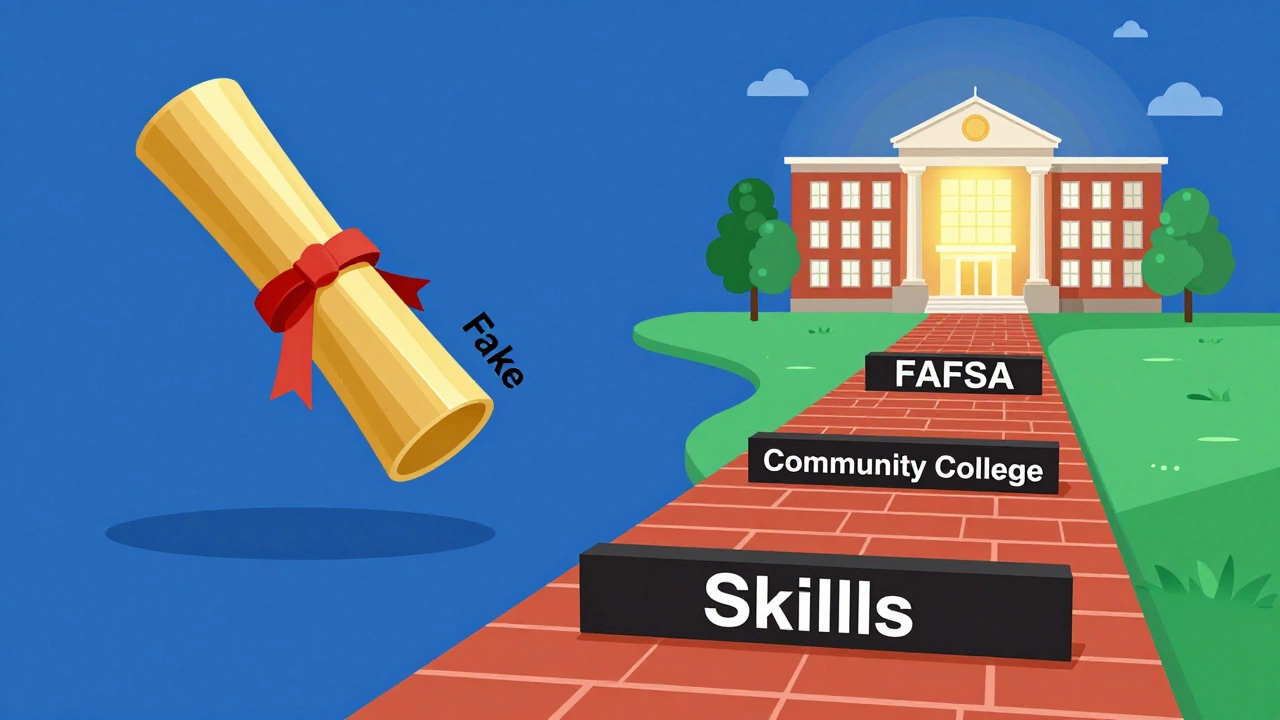
Strategic Steps to Minimize Costs
If you cannot find a completely free path, you can still keep costs low. Start at a community college for general education requirements. Transfer to a four-year university for your major. This "2+2" model can save tens of thousands of dollars. Community colleges are publicly funded and offer lower tuition rates.
Take advantage of Credit for Prior Learning (CPL). Many universities award credit for work experience, military training, or industry certifications. AP exams, IB scores, and CLEP tests can also reduce the number of courses you need to take. Fewer courses mean lower tuition bills.
Finally, consider part-time study while working. It takes longer, but you avoid student loans and gain work experience simultaneously. Many online programs are designed for working adults, offering asynchronous classes that fit around your schedule.
Conclusion: Is It Worth It?
A truly free online degree is a myth. However, a low-cost or fully funded education is achievable. It requires research, effort, and strategic planning. Look into state programs, military benefits, and full-ride scholarships. Consider alternative credentials if your career goals align with skill-based hiring. Avoid scams by verifying accreditation. Education is an investment, but it does not have to bankrupt you.
Are there any completely free accredited online universities?
No. All accredited universities have operating costs. While some offer generous financial aid or tuition-free programs for specific demographics (like veterans or low-income residents), no accredited institution provides a free degree to everyone without conditions.
Can I get a degree for free with scholarships?
Yes. Full-ride scholarships cover tuition, fees, room, and board. These are highly competitive and require excellent academic records, leadership experience, and strong essays. Examples include the Gates Scholarship and Posse Foundation.
What is the difference between a certificate and a degree?
A degree is a comprehensive academic qualification awarded by an accredited institution after completing a set curriculum. A certificate focuses on specific skills or knowledge areas and is often shorter and less expensive. Degrees are generally required for advanced careers, while certificates are valued for specialized technical roles.
Is it safe to audit courses for free?
Yes. Auditing courses allows you to learn from top universities without paying for tuition or receiving credit. Platforms like MIT OpenCourseWare and edX offer free auditing options. You will not receive a transcript or degree, but you gain valuable knowledge.
How do I verify if an online degree is accredited?
Check the U.S. Department of Education's Database of Accredited Postsecondary Institutions and Programs (DAPIP). Ensure the institution holds regional accreditation, which is the most widely accepted form. National accreditation is less recognized and often associated with vocational schools.