CBSE vs. ICSE vs. IB Syllabus Recommendation Tool
Answer three simple questions to find the educational board that best fits your child's personality and future goals.
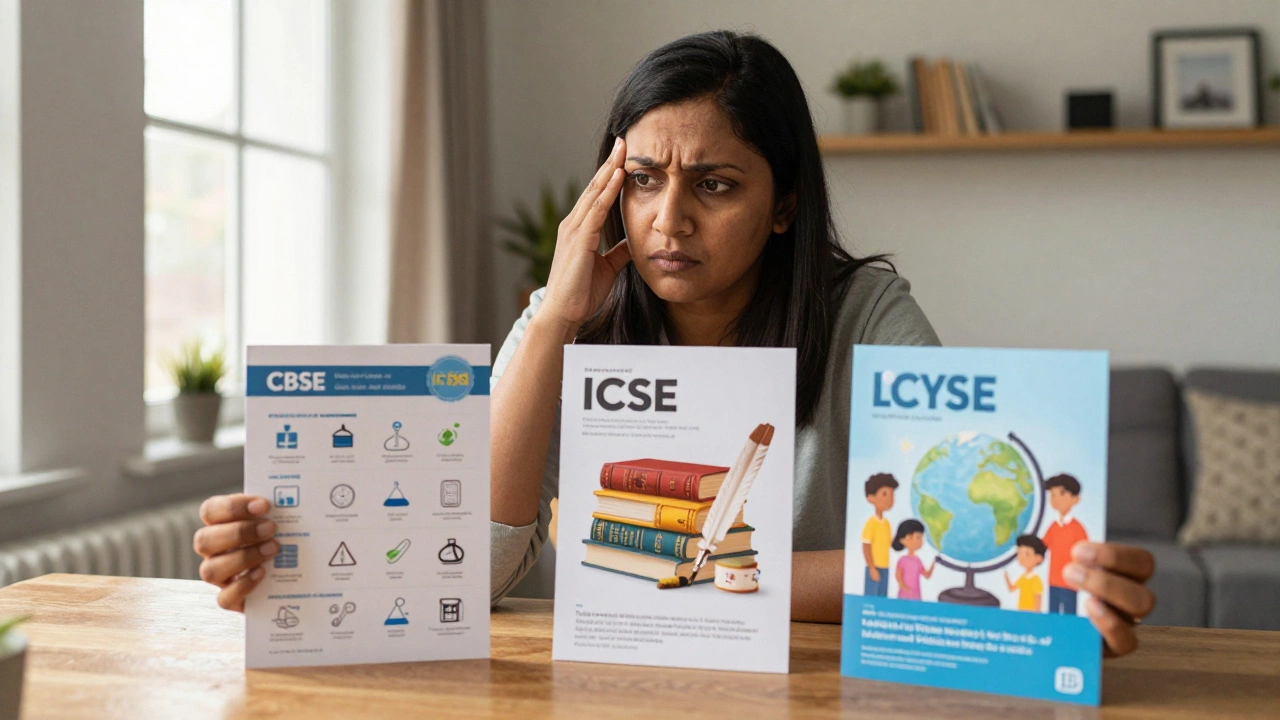
Choosing the right educational path for your child feels like picking a pair of shoes that need to fit for years. You want comfort, durability, and style, but mostly you want them to support where they are going. In India, this decision usually boils down to three major players: CBSE, Central Board of Secondary Education, the most widely adopted board known for its focus on competitive exams, ICSE, Indian Certificate of Secondary Education, famous for its detailed English literature and holistic approach, and IB, International Baccalaureate, a globally recognized curriculum focused on critical thinking and international mindedness. There is no single "best" syllabus. The right one depends entirely on your child’s learning style, your family’s future plans, and how much academic pressure you are willing to manage at home.
If you are looking for a quick answer, here is the bottom line. If your goal is engineering or medical entrance exams in India, CBSE is often the safest bet. If you value deep language skills and a broad general knowledge base, ICSE might suit you better. If you plan to move abroad or want a less exam-centric, more inquiry-based education, look into the IB curriculum.
The Case for CBSE: Structure and Competitive Edge
Let’s talk about the elephant in the room. CBSE follows a standardized pattern across India. This consistency is its biggest selling point. When your child moves from Delhi to Bangalore or Mumbai to Pune, the syllabus remains largely the same. This stability reduces transition stress, which is huge if your job requires frequent relocation.
The CBSE curriculum aligns closely with the National Curriculum Framework (NCF). It emphasizes science and mathematics heavily. For parents eyeing the IIT JEE (Joint Entrance Examination) or NEET (National Eligibility cum Entrance Test), CBSE provides a familiar foundation. The questions in these high-stakes exams often mirror the depth and style found in CBSE textbooks, especially in Physics, Chemistry, and Biology.
However, don’t let the alignment fool you into thinking it’s easy. CBSE is rigorous. The recent shift towards competency-based questions means rote memorization isn’t enough anymore. Students need to apply concepts. But compared to other boards, the volume of content is manageable. The syllabus is concise, allowing students to revise efficiently before board exams.
- Pros: Wide acceptance across India; strong alignment with national competitive exams; consistent syllabus nationwide; digital integration through DIKSHA and other platforms.
- Cons: Can feel rigid; less emphasis on creative writing and extensive reading lists; high pressure in classes 11 and 12 due to coaching culture overlap.
The ICSE Approach: Depth, Detail, and Discipline
Now, let’s look at ICSE. Run by the Council for the Indian School Certificate Examinations, this board has a reputation for being thorough-some might say exhaustive. If your child enjoys reading novels, analyzing poetry, and digging into the nuances of history, ICSE will feel like home.
The ICSE syllabus is known for its heavy weightage on English. Language proficiency is not just an add-on; it’s core. Students read substantial texts, write essays, and develop communication skills that stand out in college interviews worldwide. Beyond English, the general knowledge component is robust. Geography and History aren’t just dates and maps; they involve understanding contexts, causes, and effects deeply.
Is it harder? Yes, in terms of workload. The syllabus is vast. Students often spend more hours studying compared to their CBSE counterparts. But the payoff is a well-rounded intellect. An ICSE graduate typically possesses stronger analytical writing skills and a broader cultural awareness. If you plan to send your child to liberal arts colleges in the US or UK, this foundational breadth can be advantageous.
- Pros: Excellent English language development; comprehensive coverage of subjects; fosters discipline and attention to detail; strong emphasis on co-curricular activities.
- Cons: Heavy syllabus load; limited recognition outside India compared to IB; less direct alignment with Indian engineering/medical entrance patterns; fewer schools offer it compared to CBSE.
The IB Curriculum: Global Citizenship and Critical Thinking
Then there is the IB Diploma Programme. This isn’t just another board; it’s a philosophy. IB focuses on inquiry-based learning. Instead of feeding facts, teachers guide students to ask questions, conduct research, and form arguments. The Extended Essay and Theory of Knowledge (TOK) components are unique to IB and challenge students to think meta-cognitively-thinking about how they think.
IB is ideal if you envision a global future for your child. Universities worldwide recognize the rigor of the IB diploma. Admissions officers know that an IB student has handled a significant workload while balancing creativity, service, and academics. The grading system is transparent and standardized globally, making comparisons easier for international universities.
But beware of the myth that IB is "easier" because it lacks traditional rote learning. It is intellectually demanding. The internal assessments, external exams, and mandatory community service hours require immense time management. If your child struggles with self-discipline or prefers clear-cut right/wrong answers, IB might cause unnecessary stress.
- Pros: Globally recognized; develops critical thinking and research skills; holistic assessment including creativity and service; excellent preparation for university-level work.
- Cons: Expensive tuition fees; limited availability in tier-2 and tier-3 cities; intense workload requiring strong time management; less focus on specific Indian competitive exam patterns.

Comparing the Boards: A Practical Breakdown
To help you visualize the differences, let’s break down key attributes side-by-side. This comparison focuses on what matters most to parents: academic focus, difficulty, and future pathways.
| Feature | CBSE | ICSE | IB |
|---|---|---|---|
| Primary Focus | Science & Math; Competitive Exams | English Literature; General Knowledge | Critical Thinking; Global Perspective |
| Syllabus Volume | Moderate | High | High (but flexible within subjects) |
| Exam Pattern | Standardized, Theory-heavy | Detailed, Internal + External | Internal Assessments + External Exams |
| Best For | IIT JEE/NEET aspirants | Arts/Law/Medicine (non-JEE) | Study Abroad/Global Careers |
| Cost Factor | Affordable to Mid-range | Mid-range to High | Premium/High |
Matching the Syllabus to Your Child’s Personality
Here is where many parents go wrong. They choose the board based on prestige or peer pressure, ignoring their child’s natural inclinations. Ask yourself these questions:
- How does my child learn? Does she prefer structured lectures and clear rules (CBSE)? Or does he thrive in open-ended projects and debates (IB)?
- What are their strengths? Is math their playground? Lean towards CBSE. Is writing their passion? Consider ICSE. Are they curious about world issues and social justice? IB might ignite their spark.
- Where do you see them in 10 years? If they aim for IIT Bombay, CBSE gives a slight edge in familiarity. If they dream of Oxford or Stanford, IB or a strong ICSE background with good scores works well.
Don’t underestimate the role of the school itself. A great CBSE school with passionate teachers will outperform a mediocre IB school every time. Look for schools that balance academics with mental health. Burnout is real, especially in classes 9 through 12. Check if the school promotes sports, arts, and emotional intelligence alongside grades.

Navigating Transitions and Future Flexibility
Life changes. Jobs move. Interests shift. What happens if you switch boards midway? Transitioning from CBSE to ICSE or vice versa in middle school is manageable but requires adjustment. The teaching styles differ significantly. Moving from CBSE to IB in high school is challenging due to the drastic change in assessment methods. Most experts recommend sticking to one board from Class 6 onwards to ensure continuity.
Also, consider the flexibility of higher education. While CBSE dominates Indian engineering entrances, top universities abroad accept all boards. However, they may require additional tests like SATs or AP courses if coming from a non-IB/non-A-Level background. IB students often have an advantage here as their curriculum is already aligned with international standards.
Final Thoughts on Choosing the Right Path
There is no magic bullet. The "best" syllabus is the one that keeps your child engaged, curious, and mentally healthy. Avoid choosing based solely on what your neighbor’s child is doing. Visit schools. Talk to current students. Observe classroom interactions. Does the environment feel supportive or cutthroat?
Remember, the board is just a framework. The quality of education comes from the teachers, the peers, and the home environment. Whether you pick CBSE for its structure, ICSE for its depth, or IB for its global outlook, your involvement and encouragement matter far more than the logo on the textbook. Choose wisely, stay adaptable, and prioritize your child’s well-being over rankings.
Is CBSE better than ICSE for engineering?
Generally, yes. CBSE’s syllabus aligns closely with the IIT JEE pattern, particularly in Physics, Chemistry, and Mathematics. Many coaching institutes tailor their materials to CBSE textbooks, giving students a smoother transition to competitive exam preparation. However, ICSE students can also succeed with dedicated coaching, as the fundamental concepts are similar.
Can I switch from CBSE to IB in Grade 11?
It is possible but highly discouraged. The IB Diploma Programme starts in Grade 11, but it assumes prior exposure to inquiry-based learning and independent research. Switching late means your child must adapt to a completely different assessment style (internal assessments, extended essays) while catching up on content. Most schools require students to start IB in Grade 9 or 10.
Which board is best for studying abroad?
The IB curriculum is the most globally recognized and respected by international universities. Its focus on critical thinking and English proficiency prepares students well for Western education systems. However, strong candidates from CBSE and ICSE boards are also admitted to top universities worldwide, provided they perform well in standardized tests like SATs or ACTs if required.
Is the ICSE syllabus too difficult?
ICSE is considered more voluminous than CBSE, requiring more study hours. The difficulty lies in the depth of detail expected in subjects like English and History. It is not inherently "harder" conceptually, but it demands greater discipline and time management. Students who enjoy reading and writing often find it engaging rather than difficult.
Do schools matter more than the board?
Absolutely. A supportive school environment with qualified teachers impacts learning outcomes more than the board affiliation. Look for schools that foster curiosity, provide individual attention, and maintain a healthy work-life balance. A poor school under any board will hinder your child’s potential, while a great school can maximize it regardless of the curriculum.