
Coding Learning Timeline Estimator
Estimated Time to Job Readiness
Key Insight
...
Have you ever stared at a screen for three hours, only to realize your mistake was a missing semicolon on line 42? If so, you already know the answer to whether coding is tough. It’s not just hard; it’s frustratingly complex. But here’s the twist: millions of people do it every day, and many say it’s the most rewarding career they could have chosen. So, what makes coding feel like climbing Everest one day and walking in the park the next?
The Mental Gym: Why Your Brain Feels Like It’s Burning
Coding isn’t just typing fast. It’s a high-level mental workout that demands logic, patience, and creativity all at once. When you write code, you’re essentially giving precise instructions to a machine that follows them literally. If you miss a tiny detail, the whole thing crashes. This requires a type of thinking called computational thinking, which is the process of breaking down complex problems into smaller, manageable parts.
Imagine trying to explain exactly how to make a peanut butter and jelly sandwich to an alien who has never seen food before. You can’t just say "spread the jam." You have to say, "pick up the knife, dip it into the jar, apply pressure to the bread, move the knife left, then right." That level of precision is exhausting. Your brain has to hold multiple variables in memory at the same time-variables, loops, conditions, and data structures. For beginners, this cognitive load feels overwhelming. It’s normal to feel stupid when starting out. Even senior developers at top tech companies admit to feeling lost when tackling new frameworks.
The difficulty spikes when you encounter bugs. A bug is simply an error in the code, but finding it is like looking for a needle in a haystack made of other needles. You might spend days tracking down a single typo. This process, known as debugging, tests your resilience more than your intelligence. It teaches you to be methodical, to isolate variables, and to accept failure as part of the learning curve.
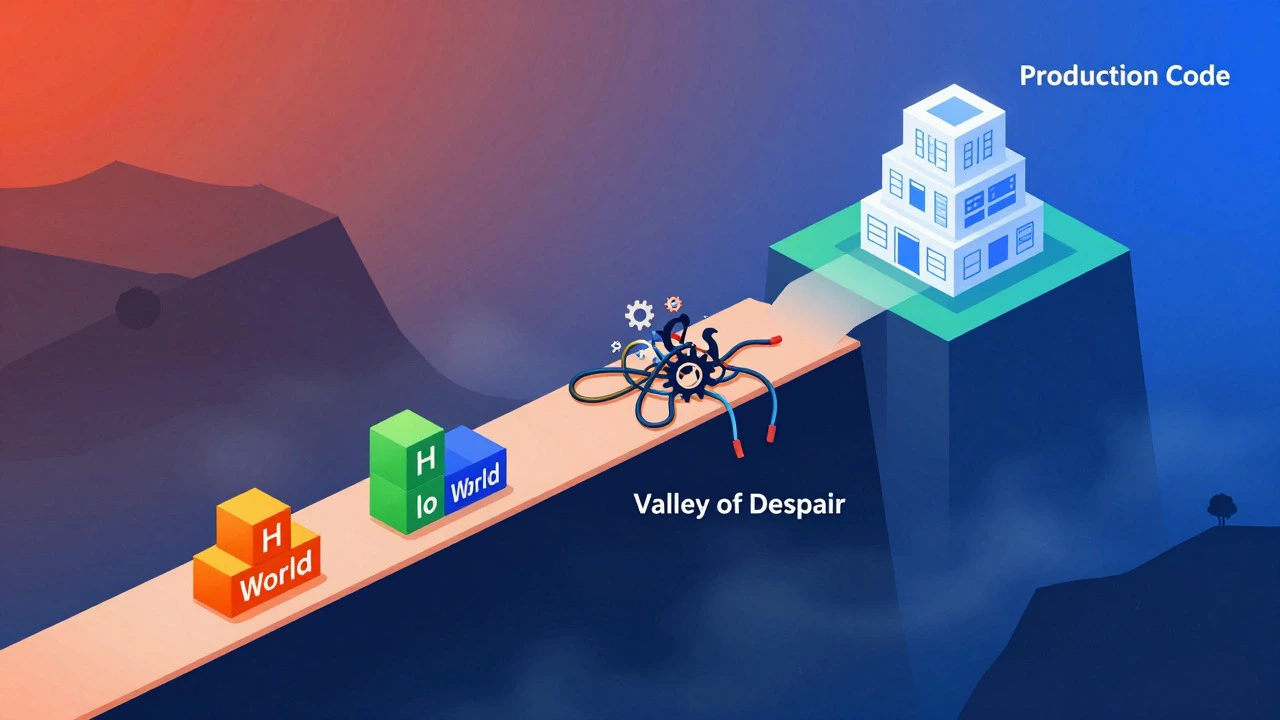
The Learning Curve: From Hello World to Production Code
Let’s talk about the journey. Most people start with languages like Python, which is designed to be readable and beginner-friendly. Python lets you write simple scripts quickly, which gives you early wins. You build a calculator, a to-do list, or a basic website. It feels easy. Then, you hit the wall.
This wall usually appears when you move from writing isolated scripts to building full applications. Suddenly, you need to understand databases, user authentication, server-side logic, and front-end design. You need to learn how different pieces of software talk to each other via APIs (Application Programming Interfaces). This shift from "making things work" to "making things scalable and secure" is where many quit.
Here is a realistic timeline for someone taking serious coding classes or self-studying:
- Months 1-3: You learn syntax. You can write loops and functions. You feel like a wizard.
- Months 4-6: You try to build a real project. Everything breaks. You feel incompetent. This is the "valley of despair."
- Months 7-12: You start connecting concepts. You understand why errors happen. You begin to enjoy solving puzzles.
- Year 2+: You are no longer memorizing code; you are understanding patterns. You can read documentation and figure things out independently.
The key insight here is that coding is not a talent; it’s a skill. Like playing guitar, your fingers hurt at first. After six months, you can play chords. After two years, you can improvise. The initial pain is temporary, but the plateau is real.
Why People Love It Despite the Struggle
If coding is so hard, why do people stay? Because the feedback loop is immediate and powerful. In most jobs, you don’t know if you did a good job until weeks later. In coding, you run the program, and it either works or it doesn’t. When it works, there is a genuine dopamine hit. You created something from nothing. You typed words, and suddenly, a chatbot replies, a game character jumps, or a database sorts thousands of records instantly.
There is also the creative freedom. Developers are digital architects. You decide how the application looks, feels, and behaves. You can automate boring tasks, build tools that help others, or create art with code. The barrier to entry is low-you just need a laptop and internet-but the ceiling is infinite. You can build a startup, join a Fortune 500 company, or work remotely from anywhere in the world.
Furthermore, the community is surprisingly supportive. Platforms like GitHub and Stack Overflow allow developers to share code and help each other debug. You are rarely alone. If you get stuck, someone else has likely faced the same problem and posted the solution online. This collective knowledge base lowers the difficulty significantly compared to learning a skill in isolation.
Common Pitfalls That Make Coding Feel Impossible
Many people think coding is too hard because they approach it wrong. Here are the biggest mistakes beginners make that artificially increase the difficulty:
- Tutorial Hell: Watching endless videos without typing code yourself. You feel like you understand, but when you open a blank editor, you freeze. You must build projects, even bad ones, to learn.
- Perfectionism: Trying to write perfect code on the first try. Good code is written by rewriting bad code. Start messy, then clean it up.
- Ignoring Fundamentals: Jumping into complex frameworks like React or Angular before understanding basic JavaScript. It’s like trying to run before you can walk. Stick to the basics until they become second nature.
- Comparing Yourself to Experts: Looking at senior engineers’ clean code and feeling inadequate. Remember, they spent thousands of hours making those mistakes. You are comparing your chapter 1 to their chapter 20.
Avoiding these pitfalls doesn’t make coding easy, but it makes it manageable. It shifts the focus from "am I smart enough?" to "what specific concept do I need to practice?"
How Coding Classes Can Bridge the Gap
Self-teaching is possible, but it’s inefficient. Structured coding bootcamps or intensive training programs that teach practical web development skills provide a roadmap. They force you to build projects, review your code, and collaborate with peers. This social accountability keeps you moving through the difficult phases.
In a classroom setting, you get immediate feedback. Instead of spending three days guessing why your code fails, a mentor can point out the issue in three minutes. This accelerates the learning curve dramatically. Additionally, classes often cover industry best practices, version control with Git, and deployment strategies-topics that are hard to find in free tutorials.
However, not all classes are equal. Look for programs that emphasize project-based learning over lecture-based theory. You want to spend 80% of your time coding and 20% listening. The goal is to build a portfolio that proves you can do the job, not just pass a test.

Comparison: Self-Study vs. Structured Learning
| Feature | Self-Study | Coding Classes/Bootcamps |
|---|---|---|
| Cost | Low ($0 - $50/month) | High ($5,000 - $20,000+) |
| Pace | Flexible, but often slow | Fast, structured schedule |
| Feedback | Delayed (forums/AI) | Immediate (mentors/peers) |
| Accountability | Low (easy to quit) | High (deadlines/peers) |
| Networking | Minimal | Strong (career services) |
The choice depends on your discipline and budget. If you are highly motivated and resourceful, self-study works. If you need structure and support, investing in a class reduces the emotional toll of the learning process.
Is It Worth It in 2026?
With the rise of AI coding assistants, some ask if humans will still need to code. The answer is yes, but the role is changing. AI can write boilerplate code, but it struggles with complex architecture, business logic, and nuanced user requirements. Developers now act more like editors and architects, reviewing AI-generated code and integrating it into larger systems. This actually makes the job less tedious but requires deeper conceptual understanding. You need to know enough to judge if the AI’s suggestion is correct.
The demand for skilled developers remains high. Companies need people who can solve problems, not just type syntax. If you can combine coding skills with domain knowledge (like healthcare, finance, or education), you become invaluable. The difficulty hasn’t disappeared; it has shifted from memorization to critical thinking.
Do I need to be good at math to code?
For most web and app development, basic arithmetic is enough. You don’t need calculus or advanced algebra. However, if you want to work in data science, machine learning, or game physics, stronger math skills are essential. For general software engineering, logical reasoning matters more than mathematical calculation.
How long does it take to get a job after learning to code?
It varies widely. With intense study (40+ hours/week) in a bootcamp, some land jobs in 3-6 months. Self-taught developers often take 1-2 years. The key factor is your portfolio. Employers care less about your degree and more about what you can build. Focus on creating 3-5 solid projects that solve real problems.
What is the hardest part of coding for beginners?
The hardest part is dealing with ambiguity and frustration. Unlike school subjects with clear answers, coding often involves vague errors and multiple ways to solve a problem. Beginners struggle with not knowing where to start or how to debug when everything breaks. Building resilience and learning to search for solutions effectively are crucial skills.
Can AI replace coders completely?
Not yet. AI tools like GitHub Copilot assist developers by suggesting code snippets, but they lack context awareness and strategic thinking. Humans are needed to define problems, design system architecture, ensure security, and maintain quality. AI changes the workflow, making developers faster, but it doesn’t eliminate the need for human oversight and creativity.
Which programming language should I start with?
Python is often recommended for beginners due to its readable syntax and versatility. JavaScript is essential if you want to build websites, as it runs in every browser. Both have large communities and plenty of learning resources. Choose based on your goals: Python for data/backend, JavaScript for web/frontend.