
Self-Taught Developer Hireability Calculator
Assess Your Readiness
Answer these questions honestly to determine how competitive you are in the 2026 job market as a self-taught coder.
Your Result
Complete the assessment to see your hireability score and personalized advice.
Here is the hard truth: yes, self-taught coders get hired. But not because they watched a few YouTube tutorials and hoped for the best. They get hired because they built things that work, solved real problems, and proved they could communicate with non-technical people. In 2026, the tech industry has moved past the "bootcamp gold rush" of the early 2020s. Employers are more skeptical than ever about entry-level candidates who lack formal degrees or structured training. However, they are also more desperate than ever for talent that can actually ship code.
If you are trying to break into tech without a computer science degree, you need to stop thinking like a student and start thinking like a product manager. Your goal isn't to learn every framework. Your goal is to prove you can deliver value. This guide breaks down exactly how self-taught developers are landing roles in today's market, what skills actually matter, and how to build a portfolio that gets you past the resume filter.
The Shift in Hiring: Why Skills Beat Degrees Now
A decade ago, a Bachelor’s degree in Computer Science was almost mandatory. Today, companies like Google, Alphabet Inc., Apple, and IBM have publicly dropped degree requirements for many engineering roles. Why? Because the half-life of technical knowledge is shrinking. What you learned in university four years ago might be obsolete today. Companies care less about where you learned to code and more about whether you can adapt quickly.
This shift creates an opportunity, but it also raises the bar. When everyone can access free resources like freeCodeCamp or The Odin Project, knowing syntax is no longer a differentiator. The differentiator is application. Employers want to see that you can take a vague idea and turn it into a working product. They want to know if you can debug errors, read documentation, and collaborate with others. These are soft skills that self-taught developers often struggle to demonstrate unless they actively seek out collaborative environments.
| Factor | Computer Science Degree | Self-Taught Developer |
|---|---|---|
| Initial Barrier | High (Time & Cost) | Low (Access to Info) |
| Proof of Competence | GPA & Projects | Portfolio & GitHub Activity |
| Networking | Campus Recruitment | Community Events & Online Presence |
| Learning Curve | Structured Theory | Practical Application |
| Interview Focus | Data Structures & Algorithms | System Design & Coding Challenges |
Building a Portfolio That Actually Gets You Noticed
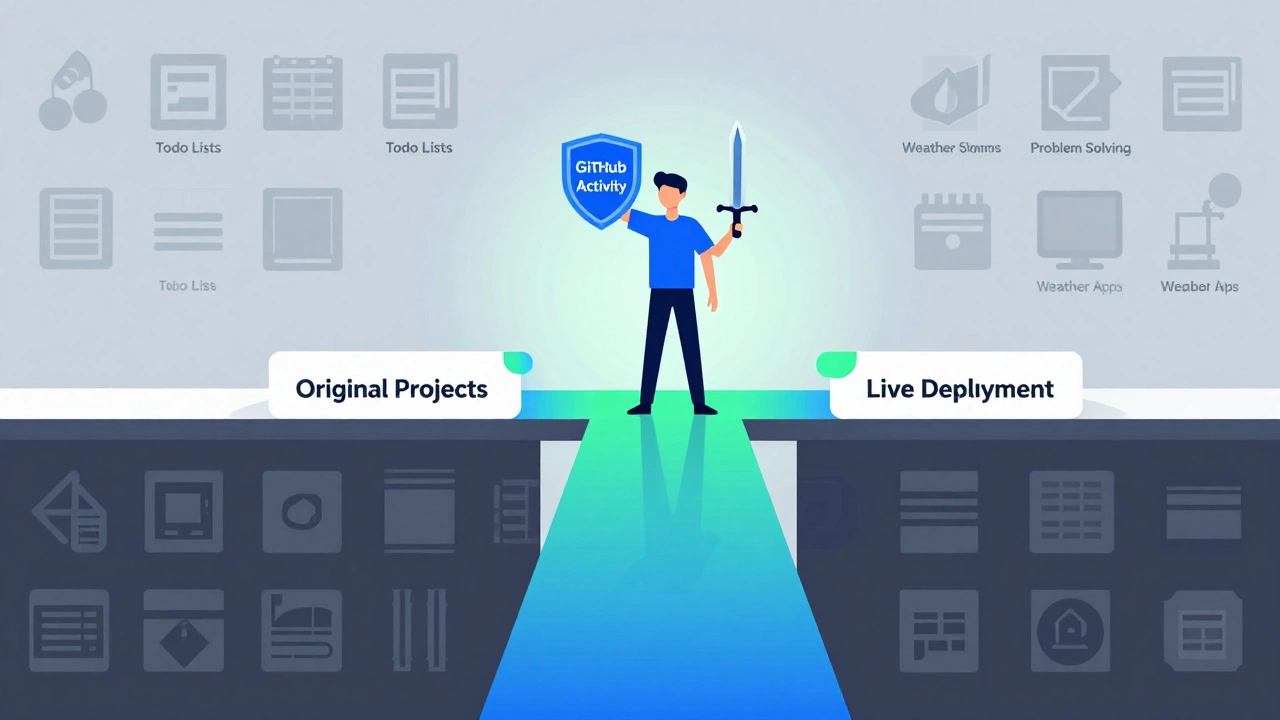
Your portfolio is your resume on steroids. If you are self-taught, your portfolio is the only thing standing between you and rejection. Most beginners make the same mistake: they build tutorial projects. A todo list, a weather app, a clone of Netflix. Recruiters see these thousands of times a day. They do not prove anything except that you can follow instructions.
To stand out, you need to build original projects that solve specific problems. Think about your hobbies, your local community, or inefficiencies in your current job. Did you notice that your local gym had terrible booking software? Build a better one. Do you love tracking your personal finances? Create a dashboard that visualizes your spending habits using real data. The key is specificity. A project that says "I built a budget tracker for freelance designers" is infinitely more compelling than "I built a budget tracker."
Here is what makes a portfolio project hireable:
- Deployment: It must be live. Host it on Vercel, Netlify, or AWS. If I have to ask for the code to run locally, I am already losing interest.
- Documentation: Include a README file that explains what the project does, why you built it, and how to use it. This shows communication skills.
- Complexity: Include at least one challenging feature. Authentication, payment processing via Stripe, or real-time updates via WebSockets. Show you can handle edge cases.
- Code Quality: Use proper linting, formatting, and commit messages. Clean code suggests you will be easy to work with.
Mastering the Tech Stack: Depth Over Breadth
One of the biggest traps for self-taught developers is "tutorial hell." You jump from JavaScript to Python to Rust to Go, learning just enough to feel overwhelmed but not enough to build anything substantial. In 2026, specialization is still king for entry-level roles. You need to pick one stack and master it.
For front-end roles, the dominant stack remains React paired with TypeScript. Knowing React alone is not enough anymore. TypeScript is now the standard for large-scale applications. If you apply for a React role without TypeScript experience, you are immediately behind candidates who took structured courses. For back-end roles, Node.js and Python (with frameworks like Django or FastAPI) remain strong choices. PostgreSQL is the database of choice for most startups and mid-sized companies.
Don't try to learn everything. Pick a path:
- Front-End Specialist: HTML/CSS, JavaScript, React, TypeScript, Tailwind CSS, Git.
- Full-Stack Generalist: React, Node.js, Express, PostgreSQL, REST APIs, Basic AWS.
- Back-End Engineer: Python or Java, SQL, Docker, API Design, Cloud Basics.
Once you have mastered the core concepts of one stack, switching to another becomes much easier. The fundamentals of programming-loops, conditionals, data structures, state management-are universal. Your first language is the hardest. After that, you are just learning new syntax.
Networking: The Hidden Job Market
Applying to jobs online is a numbers game, and the odds are stacked against you. According to various studies, only a small percentage of applicants get interviewed through traditional job boards. The rest of the jobs are filled through referrals and networking. This is where self-taught developers can level the playing field.
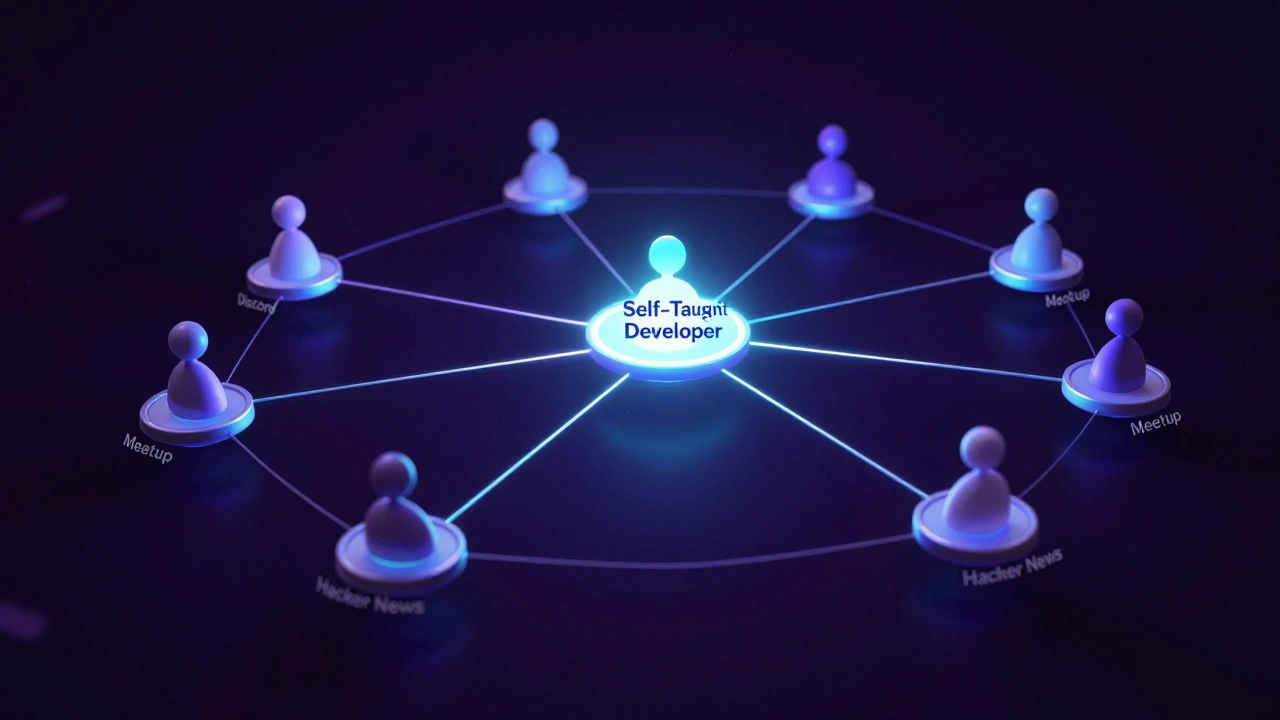
You don't need to be an extrovert to network effectively. Start by engaging in online communities. Participate in discussions on Hacker News, Reddit's r/webdev, or specialized Discord servers. Share your progress. Ask questions. Help others solve their problems. When you consistently provide value, people remember you. When you eventually look for a job, those connections become leads.
Attend local meetups or virtual events. Wellington, New Zealand, has a vibrant tech scene despite its size. Cities around the world host regular hackathons and coding workshops. These events are low-pressure environments where you can talk to engineers face-to-face. Don't walk up to someone and ask for a job. Instead, ask them about their workflow, their favorite tools, or their biggest challenges. Build relationships first. Jobs come later.
Navigating the Interview Process Without a Degree
When you land an interview, the stakes are high. Without a degree to signal "baseline competence," you must prove it during the interview process. Technical interviews for self-taught candidates often focus heavily on practical coding challenges rather than theoretical computer science questions.
Expect three types of assessments:
- Live Coding: You will be given a problem to solve in real-time on platforms like Hackerrank or LeetCode. Practice regularly. Focus on clarity and efficiency. Talk through your thought process as you code. Interviewers want to see how you think, not just if you get the right answer.
- Take-Home Projects: You may be asked to build a small feature over a weekend. Treat this like a paid gig. Write tests, document your code, and deploy it. Show professionalism.
- Behavioral Questions: How do you handle conflict? How do you learn new technologies? Use the STAR method (Situation, Task, Action, Result) to structure your answers. Highlight instances where you taught yourself something difficult or solved a complex bug.
Remember, the interviewer is not trying to trick you. They are trying to assess risk. Hiring a junior developer is expensive. They want to know if you will survive the first six months. Demonstrate resilience, curiosity, and a willingness to learn.
Overcoming Imposter Syndrome and Burnout
Self-teaching is lonely. There is no professor to tell you when you are off track. No classmates to commiserate with when a concept doesn't click. It is easy to fall into imposter syndrome, believing that you are not "real" developers because you lack a credential. Let me be clear: your code either works or it doesn't. Your degree does not change that.
Burnout is also a major risk. Many self-taught developers try to learn 8 hours a day, every day, leading to exhaustion within weeks. Sustainable learning requires rest. Aim for consistency, not intensity. Thirty minutes a day is better than eight hours once a week. Take breaks. Exercise. Sleep. Your brain consolidates learning while you rest.
Finally, celebrate small wins. Finished a module? Built a button that works? Documented a bug fix? These are victories. Track your progress. Look back at your code from six months ago. You will see how far you have come. That growth is your proof.
Can I get a job as a programmer with no degree?
Yes, absolutely. Many top tech companies have removed degree requirements. However, you must compensate with a strong portfolio, demonstrable skills, and effective networking. Focus on building real-world projects and gaining practical experience through internships or open-source contributions.
Is it harder to get hired as a self-taught developer in 2026?
It is more competitive than in previous years due to market saturation at the entry level. However, demand for skilled developers remains high. The key is differentiation. Avoid generic tutorial projects and focus on niche skills, full-stack capabilities, or specialized domains like AI integration or cybersecurity basics.
What programming language should I learn first if I'm self-taught?
JavaScript is the most versatile starting point because it allows you to build both front-end and back-end applications. Python is also excellent for beginners due to its readable syntax and wide use in data science and automation. Choose based on your career goals: web development favors JavaScript, while data/AI roles favor Python.
How long does it take to become job-ready as a self-taught coder?
Typically 6 to 12 months of dedicated study (15-20 hours per week). However, "job-ready" depends on your definition. To land an entry-level role, you need proficiency in one stack, a solid portfolio of 2-3 original projects, and familiarity with Git and basic deployment. Consistency matters more than speed.
Do employers care about bootcamps vs. self-taught?
Most employers care about skills, not the source of education. Bootcamps provide structure and networking, which can be valuable. Self-taught paths offer flexibility and cost savings. Ultimately, your portfolio and ability to pass technical interviews determine your hireability, regardless of how you learned.