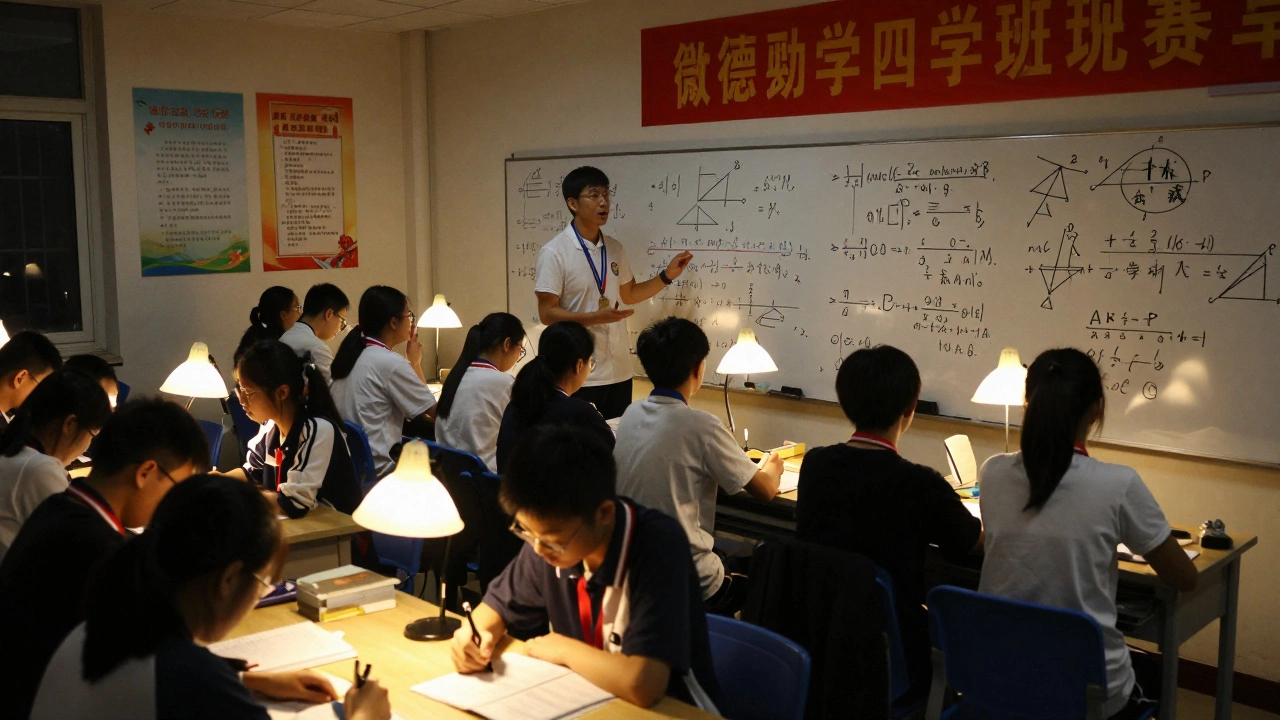
Math Olympiad Winners: How Top Students Crush Competitive Math and What It Takes to Join Them
When you hear about math Olympiad winners, students who solve problems so complex they’re designed to stump university-level mathematicians. Also known as international math competitors, these are the kids who don’t just ace exams—they rewrite the rules of how math is thought about. This isn’t about memorizing formulas. It’s about seeing patterns in chaos, spotting shortcuts no textbook teaches, and thinking three steps ahead before writing a single number.
What separates these winners isn’t just raw intelligence—it’s years of focused, deliberate practice. They train with problems that look nothing like school math. Think geometry puzzles that need creative constructions, number theory questions that feel like detective work, and algebra that bends logic until it snaps into place. Their training often starts young, but what really matters is consistency. One student from Delhi cracked the Indian National Mathematical Olympiad after solving 500+ problems in 18 months—not because he was a genius, but because he showed up every day, even when stuck.
The path to becoming a math Olympiad winner connects directly to other high-stakes exams like IIT JEE. Many top JEE rankers started with Olympiads because the problem-solving muscle they built translates perfectly to tough engineering entrance tests. The same logic that solves a combinatorics problem in the Olympiad helps you crack a complex calculus question in JEE Advanced. And it’s not just about math—skills like patience, resilience, and pattern recognition from Olympiad prep spill over into coding, physics, and even competitive exams like NEET.
These winners don’t rely on expensive coaching alone. They use free resources, join online forums, and study past papers obsessively. Some even teach themselves advanced topics like modular arithmetic or graph theory using YouTube videos and open-source textbooks. The real secret? They treat every failed attempt as data, not defeat. A wrong answer isn’t a mistake—it’s a clue.
If you’re wondering whether this path is for you, ask yourself: Do you get excited when a problem takes hours to solve? Do you enjoy the quiet thrill of finding a solution no one else saw? If yes, then you’re already closer than you think. Below, you’ll find real stories, practical guides, and proven strategies from students who made it—and the tools they used to get there.
China leads in math Olympiads, Singapore tops real-world math scores. Discover which countries excel in competitive math and why their systems work-backed by PISA and IMO data.