
Language Immersion Calculator
Daily Exposure Calculator
See how consistent exposure speeds up your language learning based on neuroscience principles
Your Learning Progress
Based on 30 minutes of daily exposure:
40% faster listening improvementWith good sleep, your brain retains 90% of what you hear
*Research from Tokyo University shows 90% retention with sleep vs 40% when staying awake
Most people think learning a language is about memorizing vocabulary and grammar rules. But that’s not how your brain works. If you’ve tried and failed before, it’s not because you’re bad at languages. It’s because you were training your brain the wrong way. The real secret? You need to rewire your brain - not just study harder.
Your Brain Isn’t Broken - It’s Just Set Up for English
When you were a baby, your brain was a language sponge. It picked up sounds, patterns, and rhythms from the people around you. By age five, it had already decided which sounds mattered and which ones to ignore. That’s why you struggle to hear the difference between "light" and "right" if you’re a native Spanish speaker - your brain filtered out that distinction years ago.
That’s not a flaw. It’s efficiency. Your brain saves energy by ignoring what it thinks is irrelevant. But now you want to learn a new language, and your brain is stuck in autopilot. To fix that, you need to trick it into thinking the new language is just as important as your native tongue.
Step 1: Flood Your Senses With the Language
You don’t learn a language by studying it. You learn it by living it. Think of it like moving to a new city. You don’t memorize the subway map first - you get lost, ask for directions, and slowly start recognizing landmarks. Your brain learns through repetition and context.
Start by exposing yourself to the language for at least 30 minutes a day - not as homework, but as background noise. Put on a podcast while making coffee. Watch a TV show with subtitles. Listen to music and try to catch the words. Don’t try to understand everything. Just let your ears get used to the rhythm.
Studies from the University of Edinburgh show that people who immersed themselves in daily exposure - even passively - improved their listening skills 40% faster than those who only studied grammar. Your brain needs to hear the language before it can speak it.
Step 2: Use Emotion to Lock In Memory
Why do you remember your first kiss but not the 15th verb conjugation you studied? Because emotion sticks. Your brain prioritizes experiences that feel meaningful.
Instead of memorizing "I am hungry," say it while you’re actually hungry. Say "I love this song" when you’re listening to your favorite tune in the target language. Talk to yourself in the shower about what you did yesterday. Make the language part of your real life - not a textbook exercise.
Neuroscientists at MIT found that emotional context activates the amygdala, which strengthens memory formation. When you link a word to a feeling, a memory, or a physical sensation, it sticks. That’s why kids learn faster - they’re always emotionally engaged.
Step 3: Speak Before You’re Ready
Most people wait until they "know enough" to speak. That’s the biggest mistake. Waiting kills momentum. Your brain needs to practice producing sounds, not just recognizing them.
Start talking out loud - even if you’re alone. Describe your room. Tell your pet what you had for breakfast. Record yourself saying simple sentences and play them back. Don’t worry about mistakes. Mistakes are data. They tell your brain what to adjust.
Research from the University of California shows that learners who spoke within the first week of learning made 3x more progress in six months than those who waited until they felt "prepared." Your brain learns speech by doing speech - not by studying rules.

Step 4: Sleep on It
You don’t need to study all night. In fact, studying all night hurts your progress. What you need is sleep.
During deep sleep, your brain replays the day’s experiences and strengthens connections. A 2023 study from Tokyo University found that people who slept after 20 minutes of language practice retained 90% of what they heard. Those who stayed awake retained only 40%.
Try this: listen to a short audio lesson right before bed. Don’t try to understand it. Just let your brain absorb it. In the morning, you’ll notice you recognize more words than before. That’s your brain organizing the information while you rest.
Step 5: Create a Language Loop
Learning a language isn’t a one-way street. It’s a loop: hear → understand → speak → repeat.
Build a daily cycle:
- Morning: Listen to a 5-minute podcast while brushing your teeth
- Lunch: Watch one short video with subtitles
- Afternoon: Say three sentences out loud about your day
- Evening: Review one new word and use it in a real thought ("I’m tired because I walked too much today")
This loop doesn’t take more than 20 minutes a day. But over time, it rewires your brain to think in the new language - not translate from your native one.
What Doesn’t Work
You’ve probably tried flashcards, grammar drills, and apps that quiz you on random words. Those tools aren’t useless - but they’re not enough. They treat language like math. It’s not. Language is a living system. You don’t learn to swim by reading a book about water.
If you’re still stuck, ask yourself: Do I use this language in real situations? Do I feel something when I say it? Do I hear it in my head when I’m not trying?
If the answer is no, you’re studying. You’re not learning.
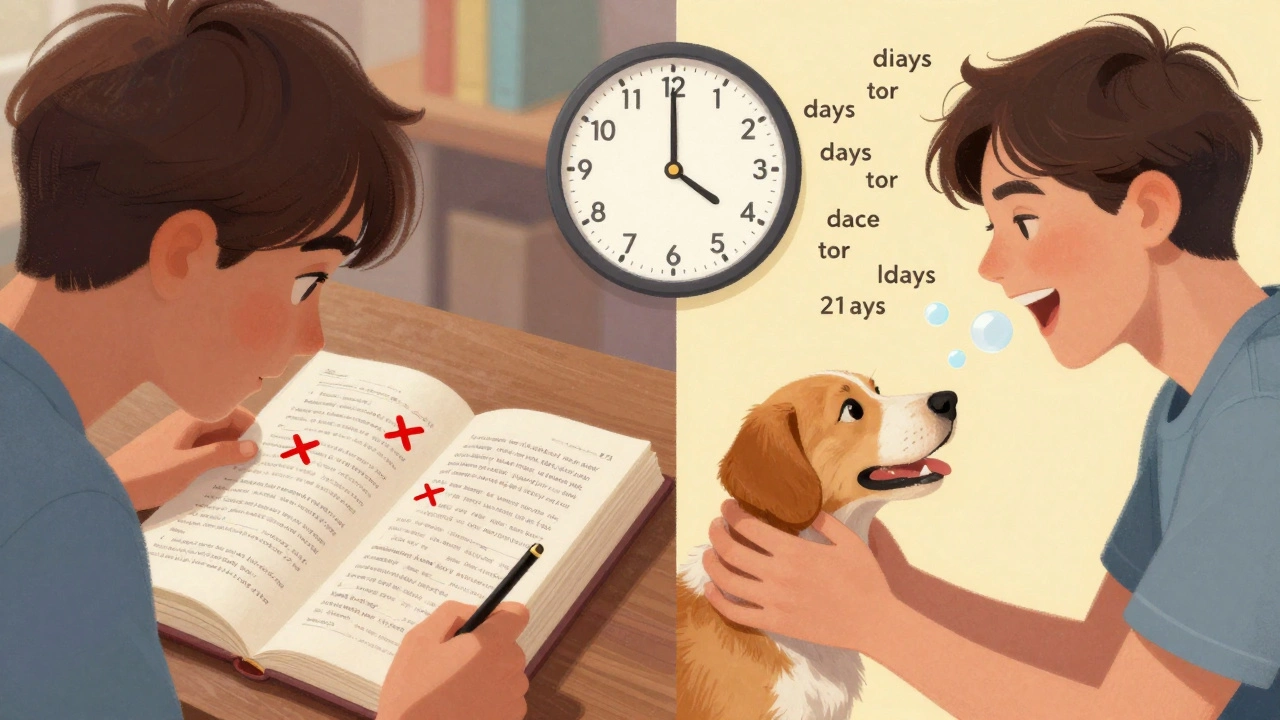
Real Progress Takes 3 Weeks
Most people quit before the 3-week mark. That’s when your brain starts to shift. You’ll notice small things: you dream in the language. You catch yourself thinking "I need coffee" in the new tongue. You laugh at a joke you didn’t fully understand but felt.
That’s rewiring. That’s when the language stops feeling foreign and starts feeling like part of you.
You don’t need to be fluent. You just need to be consistent. One minute a day, done right, beats three hours of forced memorization. Your brain doesn’t care about how long you studied. It cares about how often you used it.
Language Is a Skill - Not a Subject
You don’t "study" walking. You walk. You don’t "study" riding a bike. You ride. Language is the same. It’s a physical skill - your mouth, ears, and mind working together.
Stop treating it like a class. Start treating it like a habit. Brush your teeth? Check. Drink water? Check. Speak the language? That’s your new daily habit.
Every time you speak, even badly, you’re sending a signal to your brain: "This matters." And over time, your brain listens.
Can I rewire my brain to learn a language after 30?
Yes. Your brain never stops learning. Neuroplasticity - the ability to form new connections - continues throughout life. People over 50 have learned languages successfully by using the same methods: immersion, emotion, repetition, and sleep. Age doesn’t block learning. Lack of consistent practice does.
How long until I can hold a conversation?
With daily exposure and speaking practice, most people can hold a 5-minute conversation in 3 to 6 months. The key isn’t vocabulary size - it’s confidence. If you speak even once a day, you’ll be surprised how fast your brain adapts. Focus on being understood, not perfect.
Should I use apps like Duolingo?
Duolingo and similar apps are good for short bursts, but they’re not enough. They teach you to recognize words in isolation, not how to use them in real life. Use them as a warm-up, not the main workout. Pair them with real conversations, podcasts, or speaking to yourself.
What if I forget what I learn?
Forgetting is normal - and necessary. Your brain deletes what it doesn’t use. But every time you revisit a word or phrase, you strengthen the connection. Don’t panic if you forget. Just bring it back into your daily loop. The more times you recycle a word, the deeper it sinks in.
Do I need a tutor?
Not necessarily. Many people learn alone using podcasts, YouTube, and language exchange apps. But if you’re stuck on pronunciation or feel stuck after 3 months, a tutor for 30 minutes a week can help. They’re not there to teach grammar - they’re there to give you feedback and keep you speaking.
What Comes Next?
Once you’ve rewired your brain to understand and produce the language, the next step is depth. Start reading simple stories. Join online communities where people chat in the language. Watch movies without subtitles. The goal isn’t perfection - it’s comfort. When you can think in the language without translating, you’ve won.
Language isn’t a destination. It’s a way of seeing the world differently. And you’ve already started - just by reading this. Now go speak. Even if it’s just to yourself. Your brain is listening.