
National Merit PSAT Cutoff Estimator
Calculate Your National Merit Eligibility
Enter your PSAT section scores to see if you qualify for National Merit Semifinalist status based on estimated 2025 cutoffs.
If you're taking the PSAT in October 2025, you're probably wondering: what PSAT score qualifies for National Merit? It’s not just about getting a high score-it’s about hitting a specific number that changes every year and varies by state. This isn’t a national cutoff like the SAT. Instead, the National Merit Scholarship Corporation uses a Selection Index score based on your PSAT/NMSQT results, and only the top 1% of test-takers in each state make the cut.
How the National Merit Selection Index Works
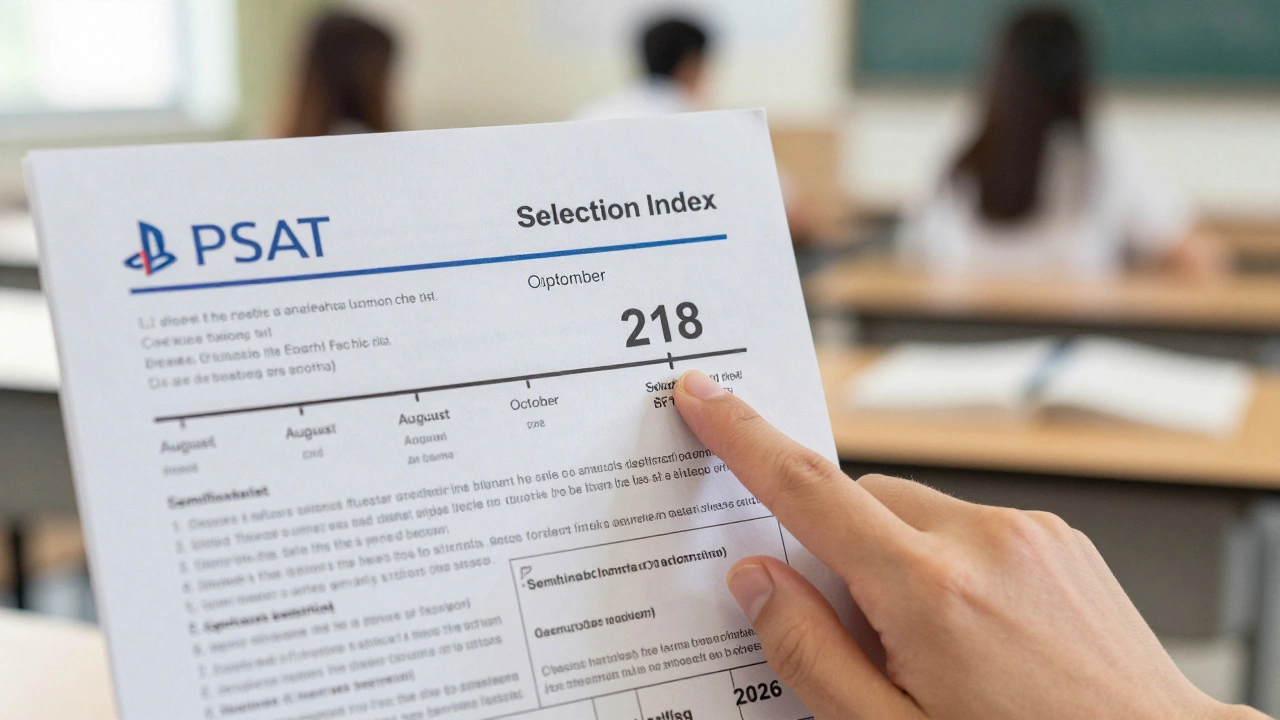
The PSAT/NMSQT has three sections: Evidence-Based Reading, Writing and Language, and Math. Each section is scored from 8 to 38. Add those three scores together and multiply by two-that’s your Selection Index. It ranges from 48 to 228.
For example, if you score 35 in Reading, 34 in Writing, and 36 in Math, your Selection Index is (35 + 34 + 36) × 2 = 210.
The Selection Index is what matters-not your total PSAT score out of 1520. That total score is useful for college applications, but for National Merit, only the Selection Index counts. The cutoffs are set each year based on how students in your state performed. You’re not competing against the whole country-you’re competing against students in your own state.
2025 National Merit Cutoffs (Estimated)
While the official cutoffs won’t be released until summer 2026, historical data gives us a solid idea of what to expect. Based on trends from 2023 and 2024, here are the estimated Selection Index cutoffs for 2025:
- Highly competitive states (California, New York, Massachusetts, New Jersey): 220-223
- Mid-tier states (Texas, Florida, Illinois, Ohio): 215-219
- Less competitive states (Montana, South Dakota, Wyoming, Alaska): 205-212
For instance, in 2024, California’s cutoff was 222. In Wyoming, it was 207. That’s a 15-point difference. The system is designed to ensure roughly the same percentage of students qualify in each state, no matter how tough the competition is.
Why State Cutoffs Exist
You might think it’s unfair that someone in Nebraska can qualify with a 208 while someone in Virginia needs a 221. But here’s why it works this way: National Merit wants to recognize top students in every state, not just those in high-performing areas. If they used one national cutoff, students from states with lower average scores would rarely make it-even if they were the top performer in their school.
This system ensures geographic diversity in the National Merit Semifinalist pool. It also means that if you live in a state with fewer high-scoring students, your odds improve. That doesn’t mean it’s easy-it just means the bar is set differently.

What Score Should You Aim For?
If you’re serious about qualifying, don’t just aim for the state average. Aim for the top 1%. That means:
- For high-competition states: Target at least a 220+ Selection Index
- For mid-tier states: Target 215+
- For lower-competition states: Target 210+
Here’s a simple rule: if you can get 36+ in Reading, 35+ in Writing, and 36+ in Math, you’re in the ballpark for most states. That’s not easy-but it’s achievable with focused prep.
Many students focus too much on the total PSAT score (out of 1520). Don’t fall into that trap. A 1450 total score might sound great, but if your section scores are 30, 31, and 34, your Selection Index is only 196-too low for almost every state.
How to Improve Your Chances
Here’s what actually moves the needle:
- Master the Writing and Language section. This is the easiest to improve quickly. Focus on grammar rules, punctuation, and sentence structure. Most students gain 2-4 points here with targeted practice.
- Don’t ignore Math. Even if you’re strong in reading, Math can drag you down. Practice no-calculator problems-they’re often trickier than they look.
- Take timed practice tests. The PSAT is as much about pacing as it is about knowledge. If you run out of time, you’ll miss points you could’ve gotten.
- Review every mistake. Don’t just re-take the test. Analyze why you got something wrong. Was it a careless error? A concept gap? A time issue?
Students who score 215+ usually have a clear study plan. They don’t wait until the week before. They start in August, take at least four full practice tests, and track their progress.
What Happens After You Qualify?
If you hit the cutoff, you become a Semifinalist in September 2026. That’s a big deal-but it’s not the end. You’ll need to submit an application, including your high school transcript, an essay, and a recommendation letter. You also need to maintain a strong GPA and take the SAT or ACT by the deadline.
Only about 90% of Semifinalists become Finalists. Many get dropped because they don’t complete the paperwork, or their GPA drops. Don’t assume qualifying is enough. Stay on top of deadlines.
Finalists are eligible for a $2,500 National Merit Scholarship, and some get corporate or college-sponsored awards that can be worth $10,000 or more per year. That’s not just a one-time bonus-it can cover tuition for years.
Common Mistakes Students Make
- Thinking a 1400+ total PSAT score guarantees qualification. (It doesn’t-check your Selection Index.)
- Believing the cutoff is the same everywhere. (It’s not. Know your state’s history.)
- Waiting until senior year to start preparing. (The PSAT is taken in 11th grade. You need to be ready by October.)
- Ignoring the Writing and Language section. (It’s the most improvable part and often the difference between 210 and 220.)
- Assuming you’ll be notified automatically. (You won’t. Schools get lists, but you should check the National Merit website in September.)
What If You Don’t Make the Cut?
Not qualifying for National Merit doesn’t mean you failed. Many top students don’t make it because they’re in a high-competition state, or they had a bad test day. That’s okay.
There are other scholarships-college-specific, local, and private-that value strong PSAT scores even if you didn’t hit the Semifinalist mark. Some schools give automatic merit aid to students with PSAT scores above 200. Others look at your SAT or ACT scores instead.
Use your PSAT score as a benchmark. If you scored 205, you’re already ahead of 85% of test-takers. That’s worth celebrating-and worth building on for the SAT or ACT.
What PSAT score do you need to qualify for National Merit?
You need a Selection Index score that places you in the top 1% of test-takers in your state. In 2025, this will likely range from 205 in low-competition states to 223 in high-competition states. The exact cutoff won’t be official until summer 2026, but historical data gives a clear range.
Is the PSAT score the same as the Selection Index?
No. Your PSAT score out of 1520 is the sum of your Reading and Math scores (each out of 760). The Selection Index is calculated by adding your three section scores (Reading, Writing, Math) from 8 to 38, then multiplying by two. Only the Selection Index matters for National Merit.
Do you need to take the SAT after qualifying?
Yes. To become a Finalist, you must submit an SAT or ACT score that confirms your PSAT performance. Your SAT score must be very close to your PSAT Selection Index. If your PSAT Selection Index was 218, your SAT score should be at least 1450-1470. A significant drop can disqualify you.
Can you qualify for National Merit if you’re homeschooled?
Yes. Homeschooled students can qualify. You must take the PSAT/NMSQT at a local high school and meet the same Selection Index cutoff as public school students in your state. You’ll also need to submit additional documentation, like a transcript and proof of homeschooling status, as part of your Finalist application.
When are National Merit cutoffs released?
The official cutoffs are released in early September each year, after the PSAT is scored and analyzed. For the 2025 test, expect cutoffs to be published around September 1-15, 2026. Your school will usually notify you, but you should also check the National Merit Scholarship Corporation website.
Does your GPA affect your National Merit qualification?
No-not for becoming a Semifinalist. Your PSAT Selection Index is the only requirement. But your GPA matters for becoming a Finalist. You must maintain a high academic record, typically a 3.5+ unweighted GPA, and submit transcripts. A drop in grades after the PSAT can disqualify you from advancing.
Final Thoughts
The PSAT isn’t just a practice test. For some students, it’s a direct path to thousands of dollars in scholarships. But it’s not a lottery. It’s a target. Know your state’s history. Know your goal. And don’t wait until the last minute to prepare.
If you’re aiming for National Merit, treat the PSAT like a scholarship exam-because it is. The difference between 210 and 220 might be a few hours of focused study. And that’s worth it.