Learning Path Finder
Answer the following questions to see which learning environment suits you best.
Recommendation
Confidence: HighAnalysis will appear here.
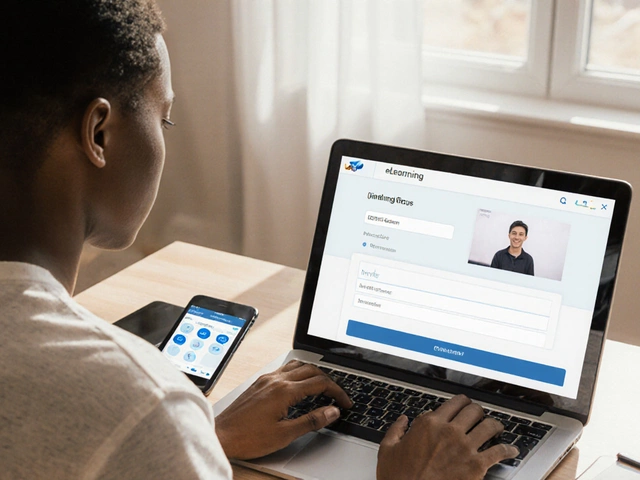
You’ve probably heard the debate a thousand times. Is sitting in a lecture hall with thirty other students actually better than watching a video at your kitchen table? It’s not just about where you sit; it’s about how your brain processes information, how you manage your time, and what kind of skills you’re trying to build. The line between eLearning and traditional classroom learning is blurring, but the core mechanics remain distinct. One relies on digital autonomy, while the other thrives on social immediacy.
The Core Mechanisms: Autonomy Versus Structure
Think of Classroom Learning as a guided tour. You move at the pace of the group. If the teacher spends twenty minutes explaining a concept you already understood, you wait. If they rush past something that confused you, you might miss it unless you speak up. This structure provides external discipline. You show up because someone expects you there. The physical presence creates a commitment device that many people struggle to replicate alone.
eLearning, on the other hand, puts the steering wheel entirely in your hands. You pause the video when you need to check a reference. You speed up through the fluff. This flexibility is a double-edged sword. For self-starters, it’s a superpower. For those who procrastinate, it’s a trap. Studies from institutions like the University of Florida have shown that while online courses offer convenience, completion rates can be lower without strict deadlines or peer accountability. The difference isn’t just technological; it’s psychological. One requires you to manage your own motivation, while the other outsources some of that management to the institution.
Social Interaction and Networking Value
Let’s talk about the people. In a physical classroom, learning is inherently social. You overhear a classmate ask a question that clarifies your own confusion. You form study groups in the hallway. These spontaneous interactions build soft skills like negotiation, empathy, and quick thinking. A survey by the National Center for Education Statistics highlights that face-to-face interaction remains a primary driver for student engagement in higher education. The "water cooler" moments matter.
Digital platforms have tried to bridge this gap with discussion boards, live chats, and breakout rooms. But let’s be honest-typing into a forum rarely replicates the energy of a heated debate in person. However, eLearning excels at connecting you with people outside your immediate geographic bubble. You might collaborate with a developer in Berlin and a designer in Singapore. If your goal is global networking rather than local community building, digital environments often win. It depends on whether you value depth of local connection or breadth of global access.

Cost, Accessibility, and Time Efficiency
Money talks. Traditional degrees come with tuition fees, housing costs, and commuting expenses. In New Zealand, for example, living costs in cities like Wellington add a significant layer to the price of attendance. eLearning strips away many of these overheads. You pay for the content, not the real estate. Platforms like Coursera or edX allow you to audit courses for free or pay a fraction of university tuition for certificates. This democratization means a single parent in rural Otago can access the same lectures as a student in Auckland.
Time is another critical factor. Commuting to campus takes an average of 30-60 minutes per day in major urban centers. Over a semester, that’s dozens of hours lost to traffic or public transport delays. eLearning reclaims that time. But does it save total time? Not always. Without the rigid schedule of a timetable, learners often spend longer on tasks due to distractions at home. The efficiency gain comes only if you have strong time-management habits. Here is a quick breakdown of typical resource demands:
| Factor | eLearning | Classroom Learning |
|---|---|---|
| Direct Cost | Low to Medium (Subscription/Tuition) | High (Tuition + Housing + Transport) |
| Time Flexibility | High (Asynchronous options) | Low (Fixed Schedule) |
| Networking Type | Global, Digital, Niche | Local, Face-to-Face, Broad |
| Self-Discipline Required | Very High | Moderate (External Pressure) |
| Feedback Speed | Variable (Automated or Delayed) | Immediate (In-Person Q&A) |
Learning Styles and Content Suitability
Not all subjects translate well to screens. Try teaching surgery via Zoom. While virtual reality simulations are improving, tactile skills still demand physical practice. Lab sciences, performing arts, and clinical rotations rely heavily on the physical environment. Conversely, theoretical subjects like history, coding, or data analysis thrive online. Coding bootcamps, for instance, have largely moved online because code lives on a screen anyway. You get instant feedback from compilers, which is faster than waiting for a professor to grade a paper.
Personalized pacing is another huge advantage of digital formats. In a classroom, the instructor teaches to the middle. Fast learners get bored; slow learners feel left behind. Adaptive learning algorithms in modern eLearning platforms adjust difficulty based on your performance. If you ace a quiz on Python loops, the system skips ahead. If you stumble on list comprehensions, it offers extra practice. This granularity allows for mastery-based progression rather than time-based progression. You don’t move on until you understand, regardless of whether the rest of the class has moved on.

The Rise of Blended Learning Models
Here’s the twist: the best approach often isn’t one or the other. It’s both. Blended learning combines the flexibility of online modules with the intensity of occasional face-to-face sessions. Many universities now adopt this hybrid model. You watch lectures online during the week, then attend weekend workshops for group projects and practical labs. This format captures the benefits of both worlds. You save time on commuting for passive listening but retain the social and practical benefits of active collaboration.
Employers are starting to recognize this shift too. A degree earned through a reputable blended program signals digital literacy and self-management alongside traditional academic rigor. When choosing a path, look for programs that explicitly design their curriculum around this synergy. Don’t just buy an online course that pretends to be a degree, and don’t cling to a traditional school that ignores digital tools. The future belongs to those who can navigate both environments effectively.
Which Path Fits Your Goals?
If you need credentials, networking, and structured discipline, stick with classroom or hybrid models. If you need specific skills quickly, want to keep working full-time, or prefer deep focus without social distraction, eLearning is likely your winner. Ask yourself: Do I learn better when someone tells me what to do next, or when I figure it out myself? Your answer should guide your choice more than any ranking chart.
Is eLearning cheaper than classroom learning?
Generally, yes. eLearning eliminates costs associated with commuting, housing, and campus facilities. However, premium online certifications can sometimes rival traditional tuition fees, so always compare the total cost of ownership, including your time investment.
Do employers value online degrees less than traditional ones?
The stigma has faded significantly. Employers now prioritize skills and accreditation over delivery method. As long as the institution is accredited and the curriculum is rigorous, an online degree holds similar weight, especially in tech and business sectors.
Can I network effectively through eLearning?
Yes, but differently. Online networking is broader and often more niche-focused. You connect with peers globally via forums and LinkedIn groups. It lacks the casual, serendipitous connections of a campus, but offers access to experts you’d never meet locally.
What subjects are hardest to teach online?
Hands-on disciplines requiring physical manipulation or safety supervision, such as medicine, engineering labs, culinary arts, and performing arts, are difficult to replicate fully online. These often require blended approaches with mandatory in-person components.
How much self-discipline does eLearning require?
It requires high self-discipline. Without fixed class times, procrastination is the biggest risk. Successful online learners treat study blocks like work appointments, setting strict deadlines and minimizing home distractions.