IIT Bombay Admission Probability Calculator
Your Profile
Enter your details to see where you stand.
- JEE Main Registrations: 1.2 Million+
- Qualified for JEE Adv: ~250,000
- CSE Seats (All IITs): ~1,000
- Selection Rate: ~0.08%
Result
Estimated probability based on historical closing ranks.
Getting into IIT Bombay is one of the most competitive academic challenges in the world. If you are asking how hard it is, the short answer is: brutally. But "hard" means different things to different people. For some, it’s a matter of raw intelligence. For others, it’s about endurance, strategy, and surviving a system that filters out 99% of applicants before they even see the campus gates.
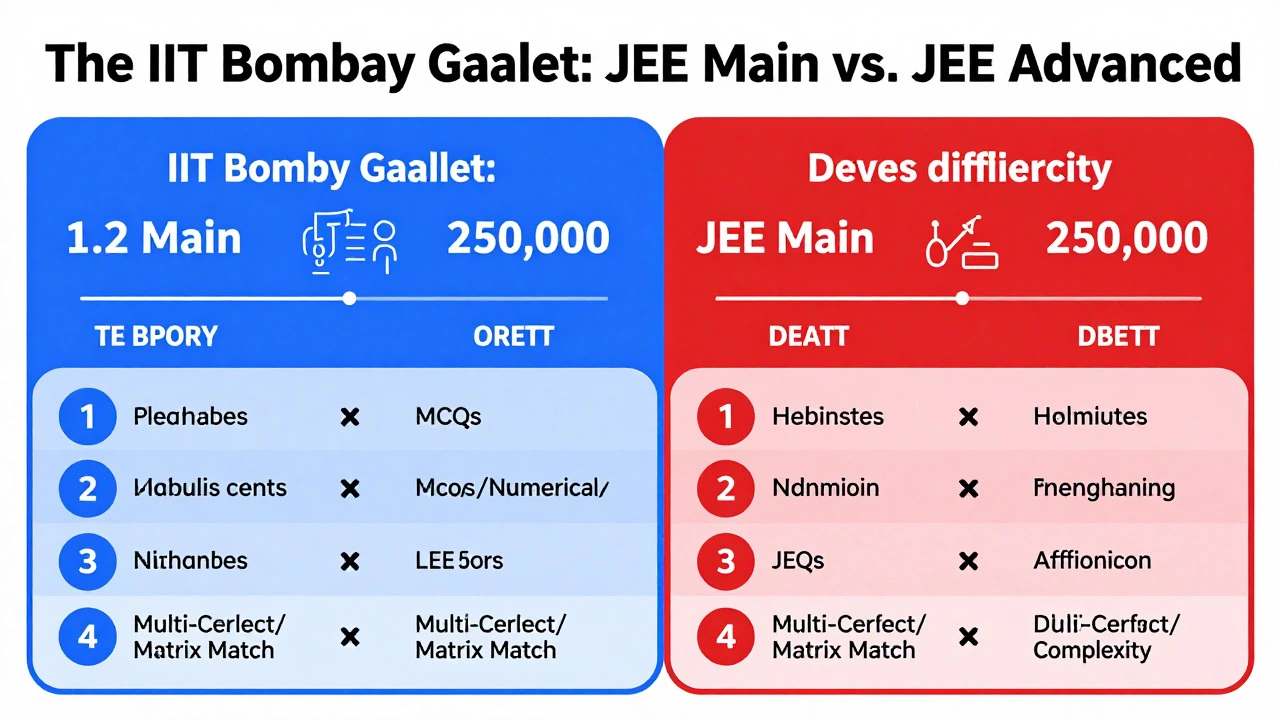
In 2025, over 1.2 million students registered for JEE Main, the first stage of the selection process. Only the top 250,000 or so qualified for JEE Advanced, the second and final stage. From that elite group, only about 1,000 seats are available across all eight Indian Institutes of Technology (IITs) for Computer Science and Engineering (CSE)-the most sought-after branch. At IIT Bombay specifically, the closing rank for CSE often hovers between 1 and 30 for general category students. That means if you are ranked 31st in the entire country, you might miss out on your dream course.
The Two-Stage Gauntlet: JEE Main and JEE Advanced
The path to IIT Bombay isn’t a single exam; it’s a two-part marathon. You cannot skip either leg. This structure is designed to test not just knowledge, but consistency under pressure.
JEE Main acts as the qualifier. Held twice a year, it tests your grasp of Physics, Chemistry, and Mathematics at a high school level, but with tricky questions that demand speed and accuracy. The competition here is fierce because the sheer number of candidates is astronomical. To clear this hurdle, you typically need to score in the top 0.5% percentile. Think of it as getting past the bouncer at an exclusive club. You don’t get in yet, but you prove you belong in the conversation.
If you pass JEE Main, you move on to JEE Advanced. This is where the real filter happens. Unlike JEE Main, which is multiple-choice heavy, JEE Advanced includes numerical value questions, matrix-match types, and multi-correct options. The syllabus overlaps with JEE Main, but the depth is significantly greater. Questions often require combining concepts from different chapters-like using calculus in physics problems or organic chemistry mechanisms in thermodynamics. The difficulty level spikes because the examiners know you have already proven your basics. Now, they want to see how you think when the obvious solution fails.
| Feature | JEE Main | JEE Advanced |
|---|---|---|
| Purpose | Qualifying exam for NITs, IIITs, and JEE Advanced eligibility | Final selection for IIT admissions |
| Difficulty Level | Moderate to High (focus on speed and breadth) | Very High (focus on depth and complex problem-solving) |
| Question Types | Multiple Choice Questions (MCQs), Numerical Value | MCQs, Multi-Correct, Integer Type, Matrix Match |
| Frequency | Twice a year | Once a year |
| Candidates Allowed | Over 1 million | Top ~250,000 from JEE Main |
What Does "Hard" Actually Mean?
When students say IIT Bombay is hard to get into, they aren’t just talking about smart kids. They’re talking about a specific type of resilience. Let’s break down the barriers.
1. The Rank Barrier
You don’t just need a good score; you need a perfect or near-perfect score. In recent years, the cutoff for General Category students in Computer Science at IIT Bombay has been around AIR (All India Rank) 1-40. For Other Backward Classes (OBC-NCL), it’s slightly higher, often up to AIR 150. For Scheduled Castes (SC) and Scheduled Tribes (ST), the ranks extend further due to reservation policies, but the competition within those categories is still intense. Missing the cutoff by even one rank can mean going to a lower-tier IIT or a different branch entirely.
2. The Mental Endurance Test
Preparation usually spans two years after completing 10th grade. During this time, students attend coaching classes for 8-10 hours a day, solve thousands of problems, and take weekly mock tests. The mental toll is significant. Burnout is common. Many talented students drop out not because they couldn’t solve the problems, but because they couldn’t sustain the pressure. Getting into IIT Bombay requires emotional stability as much as intellectual capacity.
3. The Resource Gap
Access to quality coaching matters. Cities like Kota in Rajasthan have become hubs for JEE preparation, offering structured programs, experienced mentors, and peer groups that push each other harder. Students from smaller towns or rural areas often lack these resources. While online platforms have helped bridge this gap, the self-discipline required to succeed without physical supervision is another layer of difficulty.
Who Actually Gets In?
It’s easy to romanticize the idea that only geniuses get into IIT Bombay. The reality is more nuanced. Successful candidates share certain traits:
- Consistency over Intensity: Studying 12 hours a day for a week and then burning out doesn’t work. Top performers study 6-8 hours daily, every day, for two years.
- Error Analysis: They don’t just solve problems; they analyze why they got them wrong. Keeping an error journal helps identify weak patterns.
- Mock Test Strategy: Taking full-length simulations under timed conditions builds stamina. Learning to skip difficult questions and return later is a skill honed through practice.
- Conceptual Clarity: Rote memorization fails in JEE Advanced. Understanding the "why" behind formulas allows students to tackle unfamiliar problems.
Consider Rohan, a student from Delhi who cracked IIT Bombay CSE in 2024. He didn’t start coaching until Class 11. Instead of relying solely on institute material, he focused on NCERT textbooks for fundamentals and solved previous 10 years’ JEE Advanced papers repeatedly. His secret? He treated every mistake as data, not failure.
Alternatives If You Miss the Cut
Missing IIT Bombay doesn’t mean the end of your engineering dreams. Several excellent alternatives exist:
- Other IITs: IIT Delhi, IIT Madras, and IIT Kanpur offer comparable education and placement opportunities. Branches like Mechanical, Electrical, or Civil at these institutes can lead to similar career trajectories.
- NITs and IIITs: National Institutes of Technology (NITs) and Indian Institutes of Information Technology (IIITs) provide strong technical training. NIT Trichy and IIIT Hyderabad, for example, have robust industry connections.
- Private Universities: Institutions like BITS Pilani, VIT, and Manipal University offer modern curricula and good placements, though tuition fees are higher.
- International Options: Some students use their JEE scores to apply for scholarships abroad, particularly in countries like Germany, Canada, or Australia.
Is It Worth It?
This is the question many parents and students ask. The brand value of IIT Bombay opens doors globally. Recruiters from top tech firms like Google, Microsoft, and Amazon actively recruit on campus. Alumni networks are powerful, providing mentorship and job referrals. However, success beyond college depends on skills, adaptability, and continuous learning-not just the degree.
Many successful engineers come from non-IIT backgrounds. What matters more is what you do after admission. Building projects, contributing to open-source software, internships, and networking play crucial roles in long-term career growth.
Preparing Strategically for 2027 and Beyond
If you aim for IIT Bombay, start early. Here’s a realistic roadmap:
- Class 11: Focus on building strong foundations in Physics, Chemistry, and Math. Don’t rush through topics. Understand derivations and applications.
- Class 12: Begin integrating JEE-level problems. Start taking monthly mock tests. Identify weak areas and address them immediately.
- Dropper Year (Optional): If you don’t make it in the first attempt, consider dropping a year. Use this time to refine strategies, not just repeat mistakes.
- Health Management: Sleep 7-8 hours, exercise regularly, and maintain hobbies. A healthy mind performs better than an exhausted one.
Remember, the goal isn’t just to survive the exam-it’s to thrive in the process. Whether you land at IIT Bombay or elsewhere, the discipline you build will serve you throughout life.
What is the cutoff rank for IIT Bombay Computer Science?
For General Category students, the closing rank for Computer Science and Engineering (CSE) at IIT Bombay is typically between AIR 1 and 40. For OBC-NCL, it extends to around AIR 150. SC and ST categories have higher cutoffs due to reservation policies, but competition remains intense within those groups.
Can I get into IIT Bombay with only JEE Main score?
No. JEE Main score qualifies you for NITs, IIITs, and GFTIs. To enter any IIT, including IIT Bombay, you must qualify for and appear in JEE Advanced. Your final merit list is based solely on your JEE Advanced performance.
How many hours should I study daily for JEE Advanced?
Most successful candidates study 6-8 hours daily during Class 11 and 12. Quality matters more than quantity. Include revision, problem-solving, and mock tests in your schedule. Avoid burnout by maintaining a balanced routine.
Is coaching mandatory for cracking IIT Bombay?
Coaching is not mandatory but highly beneficial. It provides structured guidance, regular assessments, and peer competition. However, self-study with disciplined planning and access to quality resources (books, online courses, previous papers) can also lead to success.
What are the best alternatives if I miss IIT Bombay?
Top alternatives include other IITs (Delhi, Madras, Kanpur), premier NITs (Trichy, Warangal), IIITs (Hyderabad, Allahabad), and private universities like BITS Pilani. These institutions offer strong academics and placement records.
Does IIT Bombay accept international students?
Yes, IIT Bombay admits international students through the Direct PhD program or via collaborations. For undergraduate admissions, foreign nationals may apply through specific quotas, but the primary route remains JEE Advanced for Indian citizens and OCI cardholders.
How does reservation affect IIT Bombay admissions?
India follows a reservation policy for SC (15%), ST (7.5%), OBC-NCL (27%), and EWS (10%) categories. Seats are allocated accordingly, meaning cutoff ranks vary by category. General category faces the highest competition due to larger applicant pool relative to seat availability.
What subjects are tested in JEE Advanced?
JEE Advanced tests three subjects: Physics, Chemistry, and Mathematics. Each subject carries equal weightage. The exam emphasizes conceptual understanding, application, and analytical skills rather than rote learning.