
MBA ROI & Cost Calculator
Program Details
Financials
Investment Analysis
Enter your details to see the verdict.
You’re staring at a brochure for a top-tier business school. The curriculum looks perfect. The network is unmatched. Then you see the sticker price: $250,000. Your stomach drops. Is it worth it? Can you even afford it? If you’ve ever wondered how expensive is an MBA, you aren’t alone. In 2026, the cost of a Master of Business Administration varies wildly depending on where you study, how you study, and what you bring to the table.
The short answer? It ranges from nearly free to over half a million dollars. But that range isn’t helpful if you’re trying to make a decision today. You need to know exactly what drives those costs up or down. Let’s break down the real numbers behind an MBA in 2026, separating marketing fluff from financial reality.
The Price Tag Spectrum: From Budget to Billionaire
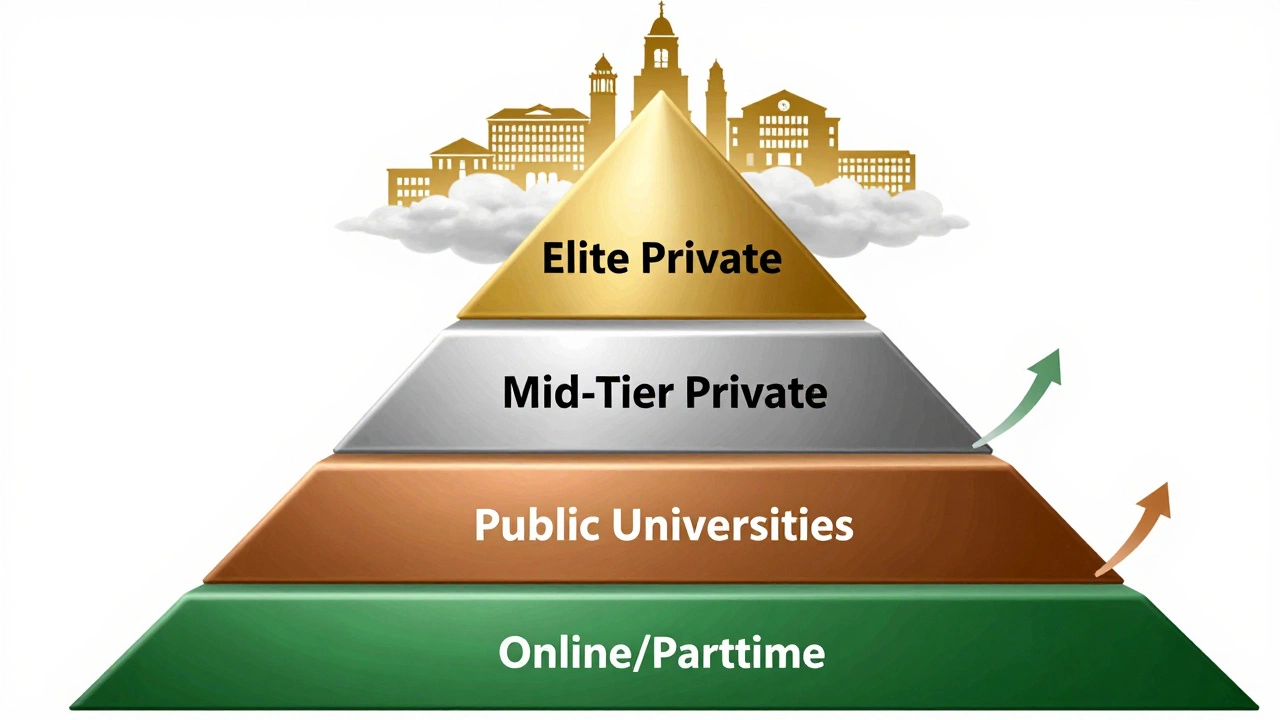
Not all MBAs are created equal, and their prices reflect that hierarchy. Think of the market like a pyramid. At the very top, you have the Ivy League and elite European schools. At the base, you have public universities and online programs. Where you land determines your debt load for the next decade.
| School Tier | Tuition Only (2 Years) | Total Cost (With Living) | Examples |
|---|---|---|---|
| Elite Private (Top 10) | $200,000 - $280,000 | $300,000 - $400,000+ | Harvard Business School, Stanford GSB |
| Mid-Tier Private | $120,000 - $180,000 | $180,000 - $250,000 | Regional private colleges |
| Public Universities (In-State) | $40,000 - $90,000 | $80,000 - $130,000 | University of Michigan Ross (in-state), UC Berkeley Haas (in-state) |
| Online / Part-Time | $20,000 - $70,000 | $25,000 - $80,000 | Indiana Kelley Direct, UT Austin McCombs |
Notice the gap between tuition and total cost. Tuition is just the entry fee. The real expense comes when you factor in housing, food, books, and lost wages. For a two-year full-time program, you aren’t just paying for classes; you’re paying for two years of not earning a salary. This "opportunity cost" often doubles the actual financial hit.
Hidden Costs That Blow Up Your Budget
When schools publish their tuition rates, they rarely mention the extras. These hidden costs can add $10,000 to $30,000 to your bill without warning.
- Relocation: Moving across the country or overseas for a program isn’t cheap. Flights, shipping furniture, and temporary housing during apartment hunts eat into savings fast.
- Networking Events: Career fairs, alumni mixers, and case competitions require travel. Attending three major recruiting trips in Chicago, New York, and San Francisco can easily cost $5,000 in flights and hotels alone.
- Technology & Materials: While textbooks are cheaper than before, many programs require specific software licenses, tablets, or premium cloud services for group projects.
- Student Fees: Mandatory activity fees, health insurance mandates, and campus service charges are non-negotiable and often increase annually.
Don’t forget the emotional tax. Stress leads to spending. When you’re overwhelmed with case studies, you might order takeout instead of cooking, or buy new clothes to feel fresh for interviews. These small leaks sink budgets.
Funding Your Degree: Loans vs. Scholarships vs. Savings
Most students don’t pay cash upfront. They finance. But financing strategies differ drastically based on risk tolerance.
Student Loans: The Double-Edged Sword
In the US, federal loans offer fixed interest rates and income-driven repayment plans. Private loans vary by credit score but often lack borrower protections. As of 2026, average graduate student loan debt exceeds $80,000. Taking on $200,000 in debt requires a guaranteed high-paying job post-graduation. If you plan to switch industries-say, from engineering to non-profit management-the ROI calculation changes completely.
Scholarships: Merit vs. Need
Elite schools award significant merit-based scholarships to attract diverse cohorts. Full rides are rare but exist for exceptional candidates with unique backgrounds (e.g., military veterans, athletes, or entrepreneurs). Need-based aid is more common at private institutions than public ones. Always apply early. Scholarship committees often allocate funds on a rolling basis.
Employer Sponsorship
If you’re currently working, check if your company offers education benefits. Many large corporations will cover 50% to 100% of tuition if you commit to staying for two years after graduation. This is the golden ticket. It reduces debt to zero while keeping your income stream intact. Just read the fine print regarding clawback clauses if you leave early.
The ROI Equation: Will You Earn It Back?
Cost doesn’t matter if the return is massive. But returns are no longer guaranteed. The old myth was “get an MBA, become a consultant, double your salary.” Today, the data is nuanced.
According to recent surveys by Poets&Quants and Financial Times, graduates from top 20 schools typically recoup their investment within 3 to 5 years. Mid-tier schools may take 7 to 10 years. Bottom-tier programs sometimes never break even unless the student leverages local networks effectively.
Key factors influencing ROI include:
- Industry Switch: Moving into finance or tech consulting yields higher starting salaries ($150k+ total comp) compared to operations or HR ($90k-$110k).
- Geography: Graduating in San Francisco or New York means higher salaries but also higher living costs. Adjust your net profit accordingly.
- Pre-MBA Experience: Candidates with 5+ years of experience tend to negotiate better post-MBA packages than those with 2 years.
A simple rule of thumb: If your pre-MBA salary is already above $120,000, the incremental gain from an MBA diminishes unless you aim for C-suite roles or entrepreneurship.

Cheaper Alternatives That Still Deliver Value
You don’t need to spend $300,000 to get career advancement. Several alternatives provide similar skills at a fraction of the cost.
Executive MBA (EMBA)
An Executive MBA is designed for senior professionals who continue working while studying. Classes are held on weekends or intensively once a month. Employers often sponsor these degrees because there’s no productivity loss. Tuition ranges from $80,000 to $150,000, but since you keep your salary, the net cost is lower.Specialized Master’s Degrees
If you want to pivot into data analytics, consider a Master of Science in Data Science instead. These one-year programs cost $40,000-$60,000 and teach hard skills that employers value immediately. Same for Finance, Marketing, or Supply Chain master’s degrees. They are narrower but often more practical for specific career paths.
Micro-Credentials and Certifications
Platforms like Coursera, edX, and LinkedIn Learning offer certificates from top universities (e.g., Wharton, MIT) for under $1,000. While they don’t carry the same weight as a degree, they signal upskilling to recruiters. Combine several certifications to build a portfolio without taking on debt.
Decision Checklist: Should You Pay Premium Prices?
Before signing any enrollment agreement, run through this mental checklist. Be honest with yourself.
- Do I need the brand name? If you’re targeting McKinsey, Goldman Sachs, or Google, yes. Top firms recruit heavily from top 10 schools. For other companies, skills matter more than pedigree.
- Can I work while studying? If yes, choose part-time or online. Keeping your income stream active dramatically improves ROI.
- Is my current industry stagnant? If you’re stuck in a dead-end role, an MBA can be a reset button. If you’re thriving, ask if a promotion or lateral move solves the problem first.
- Have I negotiated my scholarship? Never accept the first financial aid offer. Contact admissions. Mention competing offers. Schools compete for talent, not just money.
- What’s my exit strategy? Define your dream job title and salary five years from now. Work backward. Does the MBA bridge the gap efficiently?
An MBA is an investment, not a consumption good. Treat it like buying a house. Inspect the foundation, compare neighborhoods, and ensure the mortgage payments fit your budget. Don’t let prestige blind you to principal interest.
What is the average cost of an MBA in 2026?
The average tuition for a two-year full-time MBA in the US is approximately $130,000. However, including living expenses and opportunity costs, the total cost averages around $200,000. Elite private schools exceed $300,000, while public in-state programs can be under $100,000.
Are online MBAs cheaper than on-campus programs?
Yes, significantly. Online MBAs typically range from $20,000 to $70,000 in total tuition. They eliminate relocation costs and allow students to maintain their jobs, reducing opportunity costs to near zero. Many top-ranked schools now offer fully accredited online options.
Is an MBA worth the debt?
It depends on your career goals. For graduates entering investment banking, consulting, or tech leadership, the ROI is usually positive within 3-5 years. For those entering non-profits or creative fields, the debt burden may outweigh the salary bump. Always calculate your break-even point based on expected post-MBA salary.
Do companies still sponsor MBA tuition?
Yes, many large corporations offer tuition reimbursement or full sponsorship for EMBA or part-time programs. This is especially common in finance, healthcare, and technology sectors. Check your employee handbook or speak with HR about education benefits before applying.
What are the hidden costs of attending business school?
Hidden costs include relocation expenses, travel for networking events and recruiting trips, mandatory student fees, health insurance, and materials. Additionally, the largest hidden cost is opportunity cost-the salary you forego by not working for two years during a full-time program.
How do I maximize my MBA scholarship chances?
Apply early in the admission cycle, as funds are allocated on a rolling basis. Highlight unique personal stories, leadership experiences, and diversity factors in your essays. If you receive multiple offers, contact admissions offices to negotiate, providing evidence of competing financial aid packages.