
IIT JEE Study Schedule Generator
Create Your Study Plan
Your Personalized Study Schedule
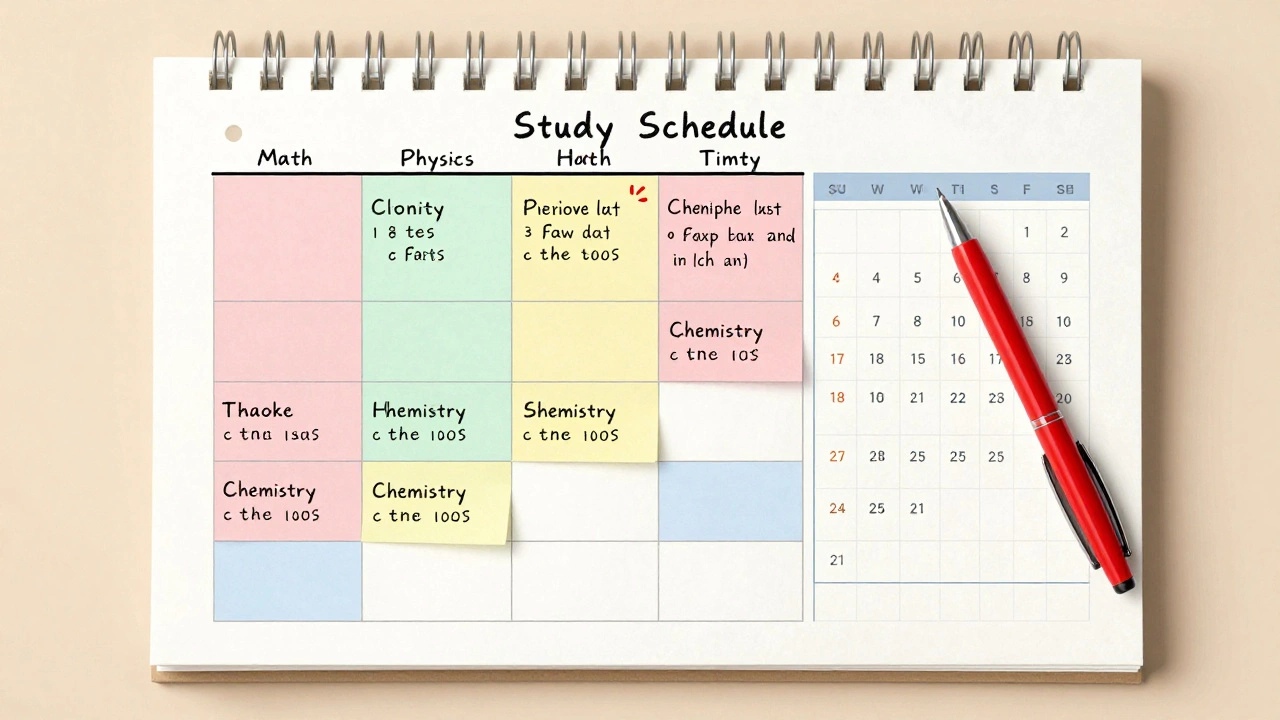
Focus on highest weightage subject with daily practice
Focus on concepts, not memorization
Organic chemistry needs daily revision
15-20 problems per subject
Analyze errors from the day
IIT JEE preparation isn’t about working harder-it’s about working smarter from day one. Every year, over 1.5 million students appear for JEE Main, but only about 25,000 make it into the IITs. The difference? Most successful candidates start early, build a clear plan, and stick to it. If you’re just beginning, don’t panic. You don’t need to be a genius. You just need consistency, clarity, and the right approach.
Understand the Exam Structure First
Before you open a single textbook, know what you’re up against. IIT JEE has two stages: JEE Main and JEE Advanced. JEE Main is the qualifying test. If you score above the cutoff, you get to sit for JEE Advanced-the real gatekeeper to IITs. Both exams test Physics, Chemistry, and Mathematics, but Advanced is tougher, with more application-based questions.
JEE Main has two papers: Paper 1 for B.E./B.Tech (which you’ll take), and Paper 2 for B.Arch/B.Planning. Focus on Paper 1. The exam is computer-based, 3 hours long, and has 90 multiple-choice questions-30 each from Physics, Chemistry, and Math. Negative marking is -1 for every wrong answer. That means guessing blindly will hurt you.
JEE Advanced has two papers, both mandatory. Questions are more conceptual, often with multiple correct answers, integer-type answers, and matching columns. No one cracks Advanced without mastering the fundamentals.
Build a Realistic Study Schedule
Most students fail because they try to study 12 hours a day and burn out in a month. You don’t need to be a night owl. You need to be consistent. Start with 5-6 focused hours a day, six days a week. Leave one day for rest or light revision.
Divide your day like this:
- 7:00 AM - 9:00 AM: Math (highest weightage, needs daily practice)
- 9:30 AM - 11:30 AM: Physics (focus on concepts, not memorization)
- 12:00 PM - 1:00 PM: Lunch and break
- 2:00 PM - 4:00 PM: Chemistry (organic needs daily revision)
- 4:30 PM - 6:00 PM: Solve 15-20 problems from each subject
- 7:00 PM - 8:00 PM: Review mistakes from the day
Weekends should be for full-length mock tests and analyzing them. Don’t just take tests-tear them apart. Why did you get that question wrong? Was it a calculation error? A concept gap? A timing issue? Write it down.
Choose the Right Books (No More Than 3 per Subject)
There’s a myth that you need 10 books per subject. You don’t. Pick one strong book per subject and master it. Here’s what top scorers use:
- Math: R.D. Sharma for basics, then Cengage or Arihant for advanced problems
- Physics: H.C. Verma for concepts, then I.E. Irodov or D.C. Pandey for tough problems
- Chemistry: NCERT for inorganic and physical, O.P. Tandon for physical, Morrison & Boyd for organic
NCERT is non-negotiable for Chemistry. Over 60% of JEE Main Chemistry questions come directly from NCERT. Read it twice. Underline key reactions. Memorize the exceptions. Don’t skip it.
Don’t collect books. Use them. Solve every example. Do every exercise. If you finish one book and still feel weak, go deeper-not wider.
Start With the Basics-No Exceptions
Many students jump straight into advanced problems because they want to feel “prepared.” That’s a trap. If you don’t understand what a derivative is, solving integration problems won’t help. If you don’t know how a buffer works, organic mechanisms will confuse you.
Start with Class 11 NCERTs. Even if you’re in Class 12, go back. Build your foundation in:
- Math: Algebra, Trigonometry, Coordinate Geometry
- Physics: Kinematics, Laws of Motion, Work-Energy, Rotational Motion
- Chemistry: Atomic Structure, Chemical Bonding, Mole Concept, Periodic Table
These topics form the backbone of 70% of JEE questions. Master them before moving to advanced topics like Electrochemistry, Thermodynamics, or 3D Geometry. Speed comes after accuracy.
Practice Daily-But Not Mindlessly
Practice isn’t about how many questions you solve. It’s about how many you understand. Solve 10 questions properly. Then solve 10 more with a timer. Then review why you got two wrong. That’s real practice.
Set daily targets:
- Math: 15 problems (mix of easy, medium, hard)
- Physics: 10 problems + 2 derivations
- Chemistry: 10 MCQs + 1 reaction mechanism written out
Keep a mistake journal. Write down the question, why you got it wrong, and the correct approach. Review this journal every Sunday. This is where real improvement happens.
Take Mock Tests Seriously
Start taking full mocks by March of Class 11. Don’t wait until Class 12. The first few mocks will be painful. You’ll score low. That’s okay. That’s data.
After every mock, answer these questions:
- Which subject had the most wrong answers?
- Did I run out of time? Where did I waste it?
- Did I skip easy questions because I overthought them?
- Which topic did I keep getting wrong? Go back to that chapter.
Use official NTA mock tests. They’re the closest to the real exam. Don’t rely on coaching institute mocks alone-they’re often harder and misleading.
Manage Your Mindset
There will be days when you feel like giving up. That’s normal. You’re competing with 1.5 million people. The pressure is real. But you’re not racing against them-you’re racing against your own progress.
Track your improvement weekly. Not your rank. Not your score compared to others. Compare your score from Week 1 to Week 4. Did you get 10 more questions right? Did you cut your silly mistakes by half? That’s progress.
Sleep 7 hours. Eat well. Walk for 20 minutes every day. Your brain needs rest to absorb what you’ve learned. No one performs well on zero sleep.

What Not to Do
- Don’t join 5 coaching centers. One good one is enough.
- Don’t chase YouTube tutorials all day. They’re supplements, not replacements.
- Don’t compare yourself to toppers on Instagram. Their journey isn’t yours.
- Don’t ignore NCERT. It’s your safety net.
- Don’t wait for motivation. Discipline beats motivation every time.
Timeline: What to Do When
If you’re starting in Class 11:
- Months 1-6: Complete Class 11 syllabus. Focus on fundamentals.
- Months 7-12: Start Class 12 topics while revising Class 11. Take first mock tests.
- Class 12, Jan-June: Finish entire syllabus. Start weekly mocks.
- July-December: Intensive revision. Solve past 10 years’ papers. Take 2 full mocks per week.
If you’re starting in Class 12:
- Months 1-4: Finish Class 11 syllabus fast. Use short notes and revision books.
- Months 5-8: Cover Class 12 topics with daily practice.
- Months 9-12: Mock tests, error analysis, past papers.
It’s harder to start late, but not impossible. Many students crack IITs even with 10-12 months of focused prep.
Final Thought
IIT JEE isn’t a test of intelligence. It’s a test of endurance, clarity, and discipline. The person who shows up every day, reviews mistakes, and stays calm under pressure will win-not the one who memorized the most formulas.
Start today. Not tomorrow. Not after the holidays. Today. Open your NCERT. Solve one problem. Write it down. That’s your first step.
Can I crack IIT JEE without coaching?
Yes, many students crack IIT JEE without coaching. Coaching helps with structure and motivation, but the real work happens when you sit alone with your books. If you’re self-disciplined, have access to good resources like NCERT, H.C. Verma, and past papers, and follow a strict schedule, you can succeed on your own. YouTube channels like Mohit Tyagi and Unacademy JEE offer free high-quality lectures. The key is consistency-not the classroom.
How many hours should I study daily for IIT JEE?
Quality matters more than quantity. 5-6 focused hours a day with active problem-solving and revision is better than 10 hours of distracted reading. If you’re in Class 11, aim for 5 hours. If you’re in Class 12 and behind, increase it to 7-8 hours-but never sacrifice sleep. Burnout is the biggest reason students fail, not lack of talent.
Is Class 11 syllabus more important than Class 12 for JEE?
Yes, Class 11 forms the foundation. Topics like Kinematics, Newton’s Laws, Algebra, Trigonometry, and Chemical Bonding are used in almost every advanced topic in Class 12. If you don’t understand these, you’ll struggle with Rotational Motion, Electrostatics, or Organic Reaction Mechanisms. About 40-45% of JEE questions are based on Class 11 concepts. Don’t rush through them.
When should I start solving previous year papers?
Start solving past papers after you’ve covered 70% of the syllabus. That’s usually around October-November of Class 12. But even in Class 11, pick 5-10 questions from past papers each week on topics you’ve studied. It helps you understand the pattern. Don’t wait until the last month. By then, it’s too late to adjust your strategy.
How important is NCERT for IIT JEE?
Extremely important-especially for Chemistry. Around 70% of JEE Main Chemistry questions come directly from NCERT. Even in Physics and Math, NCERT explains concepts clearly. Many students skip it because they think it’s too basic. But the exam tests your understanding of fundamentals, not just advanced tricks. Read NCERT line by line. Highlight key points. Re-read it twice before the exam.
What if I fail JEE Main? Can I still get into IIT?
No. You must qualify JEE Main to appear for JEE Advanced, and only those who clear Advanced get into IITs. But failing JEE Main doesn’t mean you’ve failed. Many students take a gap year, improve their strategy, and crack it the next time. Some even get into top NITs or IIITs through JEE Main scores. There are many good engineering colleges outside IITs. Don’t let one exam define your future.