Digital Learning Platform Selector
Answer the questions below to discover which of the four main digital learning platforms best fits your organization's goals.
Recommended Platform
TypeKey Features
Best For
Popular Examples
Note: Most mature organizations use a hybrid approach. This recommendation highlights your primary need.
You’ve probably heard the term "digital platform" thrown around in every meeting, webinar, and marketing pitch. But if someone asks you to name them, do you freeze? It’s a common confusion because "platform" is used for everything from Netflix to Zoom. In the world of e-learning, however, digital platforms aren't just one thing. They fall into four distinct categories, each solving a different problem for learners and educators.
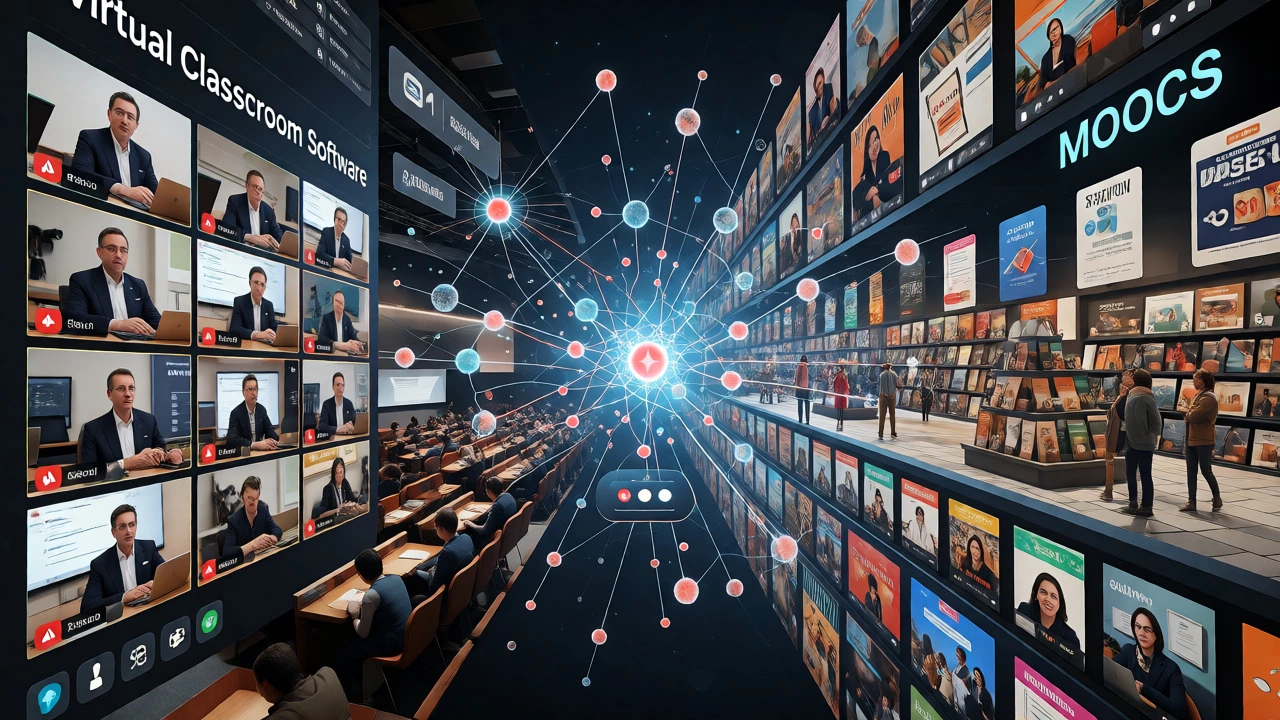
Understanding these four types helps you pick the right tool for your needs. Whether you’re building a course, training employees, or just trying to learn Python on a Tuesday night, knowing which platform fits your goal saves time and money. Let’s break down the four main types of digital learning platforms: Learning Management Systems (LMS), Massive Open Online Courses (MOOCs), Learning Experience Platforms (LXP), and Virtual Classroom Software.
The Backbone: Learning Management Systems (LMS)
Think of an LMS as the administrative backbone of online education. Its primary job is to deliver, track, and manage learning content. If you’ve ever taken a corporate compliance training or enrolled in a university course that required logging into a specific portal, you’ve likely used an LMS.
An LMS is designed for structured learning paths. It handles user registration, grades courses, issues certificates, and reports progress to managers or administrators. Popular examples include Moodle, Canvas, and Blackboard. These systems are robust but can feel rigid. They excel at standardizing training across hundreds or thousands of users, ensuring everyone sees the same material and passes the same tests.
Why choose an LMS? You need control. If you’re a school administrator or an HR manager who needs to prove that all staff completed safety training by Friday, an LMS provides the audit trail you require. It’s not about discovery; it’s about delivery and compliance.
The Marketplace: Massive Open Online Courses (MOOCs)
If an LMS is a private library, a MOOC is a public square. MOOCs democratized education by allowing anyone with an internet connection to take courses from top universities like Harvard or MIT, often for free or a low fee. The defining feature here is scale and openness.
Platforms like Coursera, edX, and Udemy host thousands of courses. Unlike an LMS, where an institution pushes content to you, a MOOC lets you pull content based on your interest. You browse a catalog, sign up, and start learning. There’s rarely a strict schedule or prerequisite check.
However, completion rates on MOOCs are notoriously low-often under 10%. Why? Because there’s no external accountability. No boss is checking your progress, and no tuition fee is burning a hole in your pocket. MOOCs are perfect for self-motivated learners looking to upskill or explore new subjects without committing to a full degree program.

The Curator: Learning Experience Platforms (LXP)
This is where things get interesting-and slightly more complex. An LXP shifts the focus from administration to experience. While an LMS asks, "Did they complete the module?", an LXP asks, "What did they actually learn, and how does it help their career?"
LXPs use artificial intelligence to curate content much like Netflix recommends movies. They aggregate resources from various sources-internal documents, external videos, podcasts, and even social media posts. Platforms like Degreed and Gloat allow learners to create personalized learning paths. If you’re interested in data science, the LXP might suggest a YouTube tutorial, a LinkedIn article, and a peer discussion group.
The key difference is flexibility. LXPs support informal learning. They recognize that learning happens everywhere, not just inside a formal course module. For modern companies trying to foster a culture of continuous learning, LXPs bridge the gap between formal training and daily skill application.
The Connector: Virtual Classroom Software
Finally, we have the tools that replicate the traditional classroom experience online. Virtual Classroom Software focuses on real-time interaction. This isn’t about pre-recorded lectures; it’s about live engagement. Think Zoom, Microsoft Teams, or specialized tools like Adobe Connect.
These platforms prioritize synchronous communication. Features like breakout rooms, live polling, whiteboarding, and screen sharing are central. They don’t typically store long-term course data or issue certifications on their own. Instead, they serve as the venue for instruction. Many educational institutions integrate this software directly into their LMS, creating a hybrid model where students watch pre-work in the LMS and discuss it live in the virtual classroom.
| Feature | LMS | MOOC | LXP | Virtual Classroom |
|---|---|---|---|---|
| Primary Goal | Administration & Compliance | Access & Scale | Personalization & Discovery | Real-time Interaction |
| User Control | Institution-controlled | Learner-controlled | AI-assisted Learner | Instructor-led |
| Content Type | Structured Modules | Video Lectures/Quizzes | Aggregated Micro-learning | Live Video/Audio |
| Best For | Corporate Training, Schools | Self-paced Upskilling | Modern Workforces | Tutoring, Live Workshops |
How to Choose the Right Platform for Your Needs
Picking the wrong type leads to frustration. If you buy an LMS when you really needed an LXP, you’ll struggle with low engagement because the system feels too bureaucratic. If you rely solely on MOOCs for mandatory compliance training, you’ll lack the reporting features auditors demand.
Ask yourself three questions:
- Do I need to track completion for compliance? If yes, you need an LMS.
- Am I trying to encourage voluntary skill-building? If yes, look at LXPs or MOOCs.
- Is live interaction critical to the learning outcome? If yes, prioritize Virtual Classroom integration.
Most mature organizations end up using a combination. A large tech company might use an LMS for annual security training, an LXP for employee development, and Zoom for weekly team workshops. Understanding the boundaries of each platform prevents overlap and wasted budget.
The Future of Digital Learning Platforms
The lines between these four categories are blurring. Modern LMS providers are adding AI-driven recommendations to mimic LXPs. MOOC platforms are introducing cohort-based models to boost completion rates. And virtual classrooms are integrating persistent chat histories that act like mini-LMSes.
As we move through 2026, expect to see more hybrid platforms that offer the administrative power of an LMS with the user-friendly interface of an LXP. The goal remains the same: make learning accessible, measurable, and engaging. By understanding the four foundational types, you can navigate this evolving landscape with confidence, choosing tools that actually serve your educational goals rather than just chasing the latest buzzword.
What is the main difference between an LMS and an LXP?
The main difference lies in their focus. An LMS (Learning Management System) is administrator-centric, focusing on delivering structured content, tracking compliance, and managing users. An LXP (Learning Experience Platform) is learner-centric, using AI to curate personalized content from various sources and encouraging self-directed learning.
Are MOOCs considered digital platforms?
Yes, MOOCs (Massive Open Online Courses) are a specific type of digital learning platform. They differ from traditional LMS platforms by being open to the public, often offering free access to high-quality university-level courses, and relying on peer-to-peer interaction rather than instructor-led grading.
Can a virtual classroom replace an LMS?
Generally, no. Virtual classroom software facilitates live interaction but lacks the robust administrative features of an LMS, such as detailed reporting, grade books, certificate generation, and structured curriculum management. Most institutions use both together.
Which digital platform is best for small businesses?
For small businesses, a lightweight LMS or a cloud-based LXP is often best. If you need simple compliance tracking, a basic LMS works. If you want to encourage employee growth and skill-sharing without heavy administration, an LXP offers better engagement and lower maintenance overhead.
Do I need coding skills to use these platforms?
No, most modern digital learning platforms are no-code or low-code solutions. Administrators can upload content, set up courses, and manage users through intuitive drag-and-drop interfaces. Coding is only necessary for deep customizations or API integrations.