
English Fluency Roadmap & Habit Tracker
Current Practice Audit
Select the activities you currently do regularly (at least 3 times a week).
Your Fluency Profile
Select your habits above and click "Generate" to see your personalized roadmap.
Imagine sitting in a coffee shop or a meeting room, knowing exactly what you want to say, but the words just won’t come out smoothly. You pause, search for vocabulary, and by the time you find it, the moment has passed. This is the frustration most learners face when trying to move from "knowing" English to speak English fluently. The good news? Fluency isn't a talent you're born with; it's a muscle you build through specific, daily training.
Many people spend years studying grammar rules and memorizing vocabulary lists, yet they still struggle to hold a conversation. Why? Because reading and writing are passive skills, while speaking is active and physical. To train yourself, you need to shift your focus from accuracy to flow. This guide breaks down the exact methods used by polyglots and language coaches to rewire your brain for spontaneous speech.
The Shadowing Technique: Mimicking Native Rhythm
You don't need to understand every word to start shadowing. In fact, at first, you shouldn't worry about meaning at all. Your goal is to train your mouth muscles to move in new patterns. English requires different tongue placements and lip movements than many other languages. If you only read silently, those muscles never get the workout they need.
Here is how to do it correctly:
- Choose the right material: Pick a short audio clip (1-2 minutes) from a podcast, YouTube video, or movie scene. Ensure the speaker has an accent you want to emulate-whether that’s General American, British Received Pronunciation, or New Zealand English.
- Listen first: Listen to the clip once without looking at any transcript. Just absorb the rhythm and melody of the speech.
- Read and listen: Now, look at the transcript while listening. Highlight words that are linked together (like "want_to" sounding like "wanna").
- Shadow aloud: Play the audio again. Try to speak along with the narrator, delaying your speech by just half a second. Don't stop if you make a mistake. Keep going.
- Record yourself: Record your attempt and compare it to the original. Notice where your pitch goes up or down differently than the native speaker.
Do this for 10-15 minutes every day. Over time, you’ll notice that your internal monologue starts to sound more like the audio you’re practicing. This bridges the gap between recognizing sounds and producing them.
Thinking in English: Killing the Translator
The biggest barrier to fluency is the mental translation process. When you hear a question, your brain translates it into your native language, formulates a response in your native language, and then translates it back into English. This takes too long. By the time you finish translating, the conversation has moved on.
To fix this, you must learn to think directly in English. Start small. You can’t jump straight into complex philosophical debates in your head, so begin with narration.
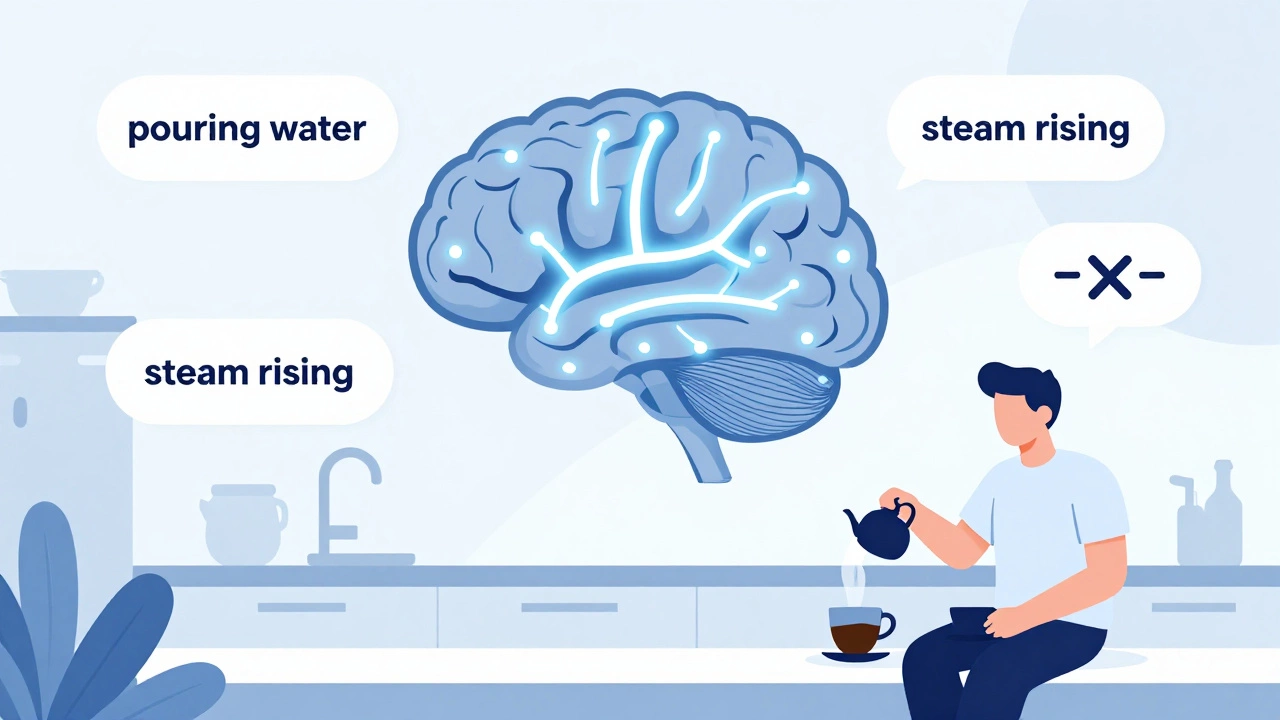
Try narrating your daily actions as you do them. As you make coffee, say to yourself, "I am pouring the water. The steam is rising. I need a spoon." If you forget a word, don't switch to your native language. Describe it instead. If you forget the word "kettle," say "the metal pot that boils water." This forces your brain to retrieve English concepts directly, bypassing the translation step entirely.
Another powerful exercise is the "Label Game." Walk around your house and label objects in your mind. But don't just say "table" or "chair." Add attributes. "The wooden table is sturdy. The red chair is comfortable." This builds associative links between the object and the English description, not the native language equivalent.
Creating an Immersion Environment at Home
You don't need to live in London or New York to immerse yourself. You can create a "micro-immersion" environment in your own home. The key is to surround yourself with English input that is slightly above your current level-a concept linguists call "comprehensible input + 1."
- Change your digital ecosystem: Switch your phone, computer, and social media accounts to English. This forces you to learn functional vocabulary related to technology and settings.
- Consume content for enjoyment, not just study: Watch TV shows or movies in English with English subtitles (not your native language). If you use native subtitles, your brain will ignore the audio and just read. English subtitles help connect the spoken word to its written form.
- Listen to podcasts during dead time: Use commute times, cleaning, or cooking to listen to English podcasts. Choose topics you already know well. If you love cooking, listen to a food podcast. Since you already understand the context, your brain can focus purely on the language structure.
The goal here is volume. You need to hear thousands of hours of English to internalize its natural flow. Passive listening counts, but active engagement (like shadowing) accelerates the process significantly.
Speaking Without Fear: The Power of Self-Talk
Most people fear making mistakes in front of others. This anxiety causes "language freeze," where you know the answer but can't produce it. To overcome this, you need to practice speaking when there is no risk of judgment. That means talking to yourself.
It might feel strange, but self-talk is a legitimate training tool. Set aside 5 minutes each day to talk about your day, your opinions, or your plans. Pretend you are explaining your life to a friend who doesn't know you.
If you get stuck, don't stop. Circumvent the problem. Say, "I'm looking for the word... it's something like..." This mimics real-life conversation strategies. Native speakers also pause and search for words. They don't stop mid-sentence and panic. By practicing this solo, you build confidence for real interactions.
You can also use voice assistants like Siri or Alexa. Ask them questions in English. "What's the weather today?" "Set a timer for five minutes." These low-stakes interactions help you get used to forming sentences spontaneously without the pressure of human eye contact.
Using Technology to Find Speaking Partners
While self-practice is crucial, you eventually need real feedback. Human interaction introduces unpredictability-interruptions, slang, fast speech, and cultural references. Fortunately, technology has made finding partners easier than ever.
| Platform | Type | Best For | Cost |
|---|---|---|---|
| Discord Servers | Community Chat | Casual conversation, text & voice channels | Free |
| Tandem / HelloTalk | Language Exchange App | One-on-one chat, correction features | Freemium |
| iTalki / Preply | Tutor Marketplace | Structured lessons, professional feedback | Paid ($10-$30/hr) |
| Meetup.com | Local Events | In-person practice groups, socializing | Free/Low Cost |
If you can afford it, hiring a community tutor (not necessarily a certified teacher) on platforms like iTalki is highly effective. You don't need formal grammar drills; you need someone to talk to for 30 minutes about your hobbies. Tell them upfront: "Please correct my major mistakes, but let me keep talking." This ensures the flow isn't broken constantly.
If you prefer free options, join Discord servers dedicated to language learning. Many have voice channels where people hang out and chat casually. Jumping into these rooms is terrifying at first, but staying silent for 10 minutes before speaking helps your ears adjust to the noise floor.

Focusing on Communication, Not Perfection
A common trap is waiting until your sentence is grammatically perfect before saying it. This leads to hesitation. In real-world communication, clarity is more important than correctness. If someone understands you, you have succeeded.
Native speakers make grammatical errors all the time. They use fragments. They interrupt themselves. They use filler words like "um," "you know," and "like." Don't be afraid to use fillers in English too. They give your brain extra time to process the next word while keeping the conversation flowing.
Instead of aiming for a C2 level of academic precision, aim for B2 level communicative competence. At B2, you can interact with native speakers with enough fluency and spontaneity that mutual strain does not occur. This is the threshold where you stop being a "student" and start being a "speaker."
Maintaining Consistency: The Habit Loop
Fluency is not achieved through marathon study sessions once a week. It is built through daily exposure. Your brain needs frequent reinforcement to retain neural pathways associated with English.
Create a habit loop. Tie your English practice to an existing habit. For example, "After I brush my teeth, I will do 5 minutes of shadowing." Or, "While I drink my morning coffee, I will listen to one news article."
Track your streak. Use an app or a calendar to mark every day you engage with English in some way. Missing one day is fine; missing two days starts a pattern. The goal is not intensity; it is consistency. Even 15 minutes a day is better than 3 hours once a month.
How long does it take to become fluent in English?
There is no fixed timeline, as it depends on your native language, previous experience, and daily effort. However, with consistent daily practice (30-60 minutes), most learners see significant improvements in speaking confidence within 3-6 months. True fluency, defined as effortless communication, often takes 1-2 years of sustained immersion.
Is it better to learn grammar or just start speaking?
For speaking fluency, prioritizing speaking over grammar is usually more effective. Grammar provides structure, but excessive focus on rules can cause hesitation. Learn basic sentence structures (Subject-Verb-Object) and then practice using them in real conversations. You will naturally acquire more complex grammar through exposure and feedback.
What should I do if I forget a word while speaking?
Don't stop. Use circumlocution-describe the word using simpler terms. For example, if you forget "umbrella," say "the thing we use in rain." You can also use filler phrases like "It's on the tip of my tongue" to buy time. This keeps the conversation moving and trains your brain to solve problems in real-time.
Can I become fluent without living in an English-speaking country?
Yes, absolutely. With modern technology, you can create a rich immersion environment anywhere. Use online tutors, language exchange apps, podcasts, and media. The key is active engagement rather than passive location. Many polyglots achieve high fluency without ever leaving their home countries.
How important is pronunciation for fluency?
Pronunciation affects intelligibility, which is crucial for communication. Poor pronunciation can lead to misunderstandings, causing frustration for both you and your listener. While you don't need a perfect accent, focusing on clear vowel sounds and stress patterns (which syllable is emphasized in a word) will significantly improve how easily others understand you.