JEE Physical Chemistry Score Impact Calculator
Your Performance Estimates
Score Analysis
Marks from
Physical Chemistry
0
Percentage of
Total Chem Marks
0%
Impact Summary:
Loading...
You stare at your notebook. The pages are filled with complex organic mechanisms and abstract inorganic exceptions. Then you look at the Physical Chemistry chapter on Thermodynamics or Electrochemistry. It looks like a math problem wearing a chemistry disguise. You think to yourself: "Why can't I just skip this part?"
If you are asking whether you can skip Physical Chemistry is the branch of chemistry that applies physics principles to chemical systems, focusing on quantitative analysis, thermodynamics, kinetics, and equilibrium. for the Joint Entrance Examination (JEE), the short answer is no. The long answer is even more critical: skipping it is the fastest way to guarantee you miss your target rank.
The Weight of the Subject in JEE Main and Advanced
To understand why skipping is not an option, you need to look at the numbers. In recent years, the pattern for both JEE Main is the national-level engineering entrance exam conducted by NTA, serving as a screening test for IITs and other engineering colleges. and JEE Advanced is the second-stage entrance exam for admission to Indian Institutes of Technology (IITs), known for its conceptual depth and multi-concept questions. has shown a consistent trend. Chemistry usually contributes about 30-35% of the total marks. Within Chemistry, Physical Chemistry typically accounts for 40-50% of the questions.
| Exam Stage | Total Chemistry Marks | Approx. Physical Chemistry Questions | Difficulty Level |
|---|---|---|---|
| JEE Main | 100 Marks (25 Qs) | 8-12 Questions | Formula-based & Direct |
| JEE Advanced | 180 Marks (Varies) | 6-9 Questions | Conceptual & Multi-step |
In JEE Main, these questions are often straightforward. If you know the formula for Raoult's Law or the Nernst Equation, you can solve them in seconds. This makes Physical Chemistry the "easiest" section to score high in if you prepare correctly. Skipping it means throwing away free marks that could secure your cutoff.
In JEE Advanced, the questions are tougher. They might combine concepts from multiple chapters, like mixing Equilibrium with Ionic Equilibrium or Thermodynamics with Chemical Kinetics. But here’s the secret: Advanced still rewards strong fundamentals. If you master the basics, you can crack these problems too. Ignoring the subject leaves you vulnerable to these high-value questions.
Why Students Want to Skip Physical Chemistry
I get it. Physical Chemistry feels different. Unlike Organic Chemistry, where you memorize reactions and mechanisms, or Inorganic Chemistry, where you memorize facts and trends, Physical Chemistry requires calculation. It requires logic. It requires patience.
Many students struggle because they treat it like pure math. They try to derive every equation from scratch during the exam. That’s a mistake. The core issue isn’t the difficulty; it’s the approach. When you skip it, you’re not saving time; you’re creating a massive gap in your understanding that affects other subjects.
Consider this: Do you really want to walk into the exam hall knowing you’ve ignored nearly half of the Chemistry paper? That anxiety alone can hurt your performance in Physics and Mathematics. Confidence comes from preparation, not avoidance.
The Interconnected Nature of JEE Chemistry
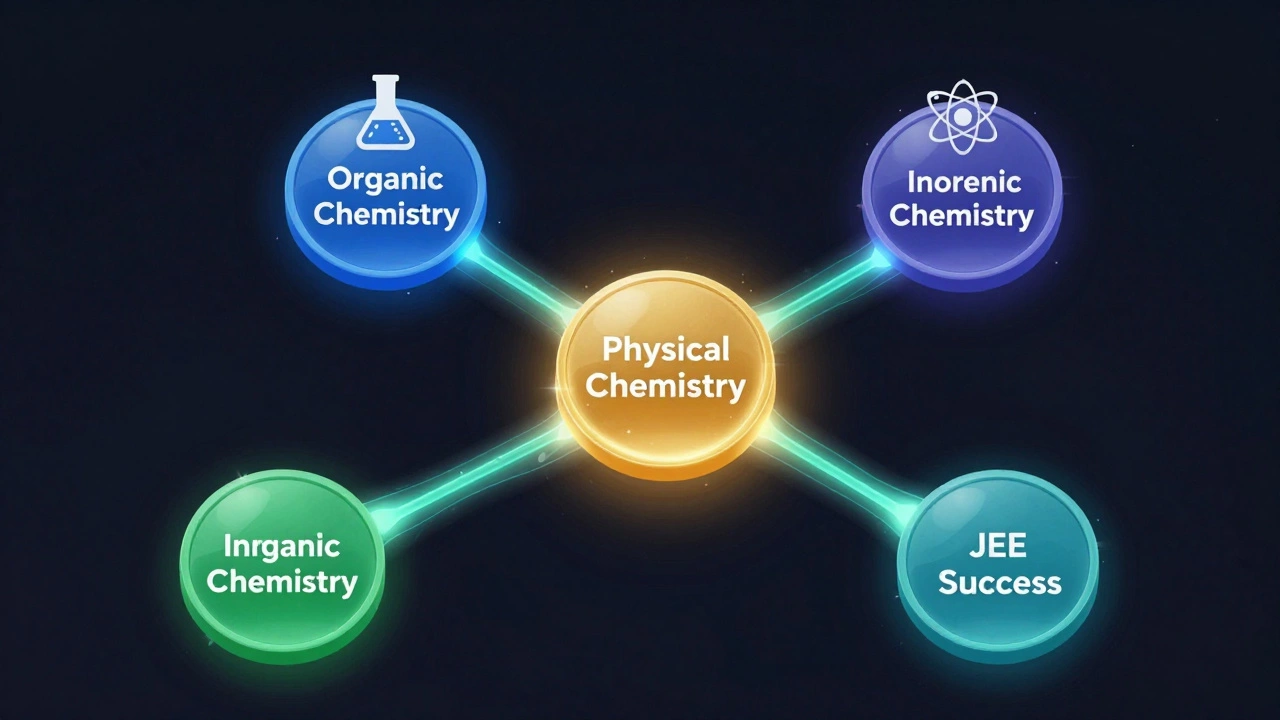
Chemistry is not three separate subjects. It is one unified science. Physical Chemistry provides the foundation for many topics in Organic and Inorganic Chemistry. Here is how skipping it hurts your broader preparation:
- Equilibrium: Understanding pH, pKa, and buffer solutions (Physical) is essential for solving Acid-Base reactions in Organic Chemistry.
- Electrochemistry: Concepts like standard electrode potential help predict the feasibility of redox reactions in Inorganic Chemistry.
- Thermodynamics: Gibbs Free Energy determines whether a reaction will occur spontaneously, which is crucial for understanding reaction mechanisms in Organic Chemistry.
- Solutions: Colligative properties are tested directly in JEE but also appear in context-based questions involving mixtures.
If you skip Physical Chemistry, you lose the ability to predict *why* a reaction happens. You’re left guessing based on rote memory, which fails when questions are twisted slightly in JEE Advanced.
High-Yield Chapters You Cannot Ignore
If you are short on time and feel overwhelmed, don’t skip the entire subject. Instead, prioritize. Some chapters offer better return on investment than others. Focus on these high-yield areas first:
- Mole Concept & Stoichiometry: The backbone of all chemistry. Master this, and calculations become easier everywhere.
- Chemical Bonding: Often classified under Physical or Inorganic, but heavily relies on quantum mechanics concepts. Essential for predicting molecular geometry.
- Thermodynamics & Thermochemistry: High weightage, direct formulas, and frequent appearance in both Main and Advanced.
- Equilibrium (Chemical & Ionic): Critical for pH calculations, solubility product, and buffers. A favorite topic for exam setters.
- Electrochemistry: Formula-heavy but predictable. Learn the Nernst Equation and Faraday’s Laws inside out.
- Chemical Kinetics: Straightforward rate laws and order of reaction problems. Easy marks if you practice numericals.
Chapters like Surface Chemistry or Nuclear Chemistry have lower weightage. You can skim these later if needed, but never neglect the core six listed above.
How to Make Physical Chemistry Manageable
Skipping is not the solution. Strategy is. Here is how to tackle Physical Chemistry without burning out:
1. Master the Formulas, Not the Derivations
You don’t need to derive the Ideal Gas Law every time. Memorize the final formula and understand its variables. Create a formula sheet for each chapter. Review it daily. Speed comes from familiarity.
2. Practice Numerical Problems Daily
Physical Chemistry is a skill, like riding a bike. You learn by doing. Solve at least 10-15 numerical problems every day. Start with easy ones from NCERT exemplars, then move to previous year JEE questions.
3. Use Dimensional Analysis
When stuck, check units. If you’re calculating pressure, ensure your answer ends up in atm or Pa. This simple trick helps eliminate wrong options in MCQs, especially in JEE Main.
4. Link Concepts to Real Life
Understanding why ice floats (density anomaly) or how batteries work (electrochemistry) makes the concepts stick. When you see the real-world application, the math feels less abstract.
5. Take Regular Mock Tests
Analyze your mistakes. Did you forget a sign in the logarithm? Did you mix up Kelvin and Celsius? Identifying these small errors prevents big losses in the actual exam.

The Risk of Shortcuts
Some coaching institutes suggest focusing only on "scoring" chapters. This advice is dangerous for JEE. The exam is designed to filter out students who take shortcuts. Every year, thousands of students skip Physical Chemistry thinking it’s too hard. They end up ranking below peers who spent extra hours mastering it.
Remember, JEE is a race against lakhs of aspirants. While you spend those hours avoiding Physical Chemistry, your competitors are solving problems faster and more accurately. By the time you realize you need those marks, it’s too late.
Final Verdict: Embrace the Challenge
Can you skip Physical Chemistry for JEE? Technically, yes. You can sit for the exam without studying it. But will you succeed? Almost certainly not.
Physical Chemistry is not just another chapter. It is the engine that drives your Chemistry score. It offers the most predictable, calculable, and high-scoring opportunities in the entire paper. Instead of fearing it, respect it. Put in the work. Master the formulas. Practice the problems.
Your dream college doesn’t care how you got there. It only cares about your rank. And your rank depends on every mark you can grab. Don’t leave money on the table. Study Physical Chemistry, and watch your confidence-and your score-soar.
Is Physical Chemistry harder than Organic Chemistry for JEE?
It depends on your strengths. If you are good at math and logical reasoning, Physical Chemistry will feel easier. If you prefer memorization and visualizing structures, Organic Chemistry might be more comfortable. However, Physical Chemistry is generally considered more predictable because answers are calculated rather than guessed.
How many hours should I dedicate to Physical Chemistry daily?
Aim for 1-1.5 hours daily. Consistency is key. Spending 5 hours once a week is less effective than 1 hour every day. Use this time to solve numerical problems and revise formulas.
Can I rely only on NCERT for Physical Chemistry?
NCERT is essential for building concepts, especially for JEE Main. However, for JEE Advanced, you need additional reference books like OP Tandon or RC Mukherjee for more challenging numerical problems and varied question types.
What is the best strategy for solving Physical Chemistry questions in the exam?
First, identify the concept being tested. Write down the relevant formula immediately. Check units carefully. Perform calculations step-by-step to avoid silly mistakes. If stuck, use dimensional analysis or approximation techniques to eliminate wrong options.
Which Physical Chemistry chapter is easiest to score?
Mole Concept and Stoichiometry are foundational and relatively straightforward. Chemical Kinetics and Electrochemistry are also high-scoring because they rely heavily on direct formula application with minimal conceptual ambiguity.