Beginner's Coding Success Estimator
Your Learning Profile
Estimated Timeline
Select your profile and click Generate to see your estimated path.
Daily Practice Strategy
Code Daily
Embrace Bugs
Build Projects
Ask for Help
Picture this: You open your laptop, ready to build that cool website or app you’ve been dreaming about. You type a few lines of code, hit run, and... nothing happens. Or worse, a wall of red error messages flashes on the screen. Your heart sinks. "Maybe I’m just not smart enough," you think. "Maybe coding isn’t for me."
If that sounds familiar, take a deep breath. You are not alone. Almost every developer, from the CEO of a major tech company to the freelancer building their first portfolio site, has felt exactly that way. The short answer to is coding hard for beginners? Yes, it can be. But no, it’s not impossible. In fact, with the right mindset and resources available in 2026, learning to code is more accessible than ever before.
The Myth of the "Natural" Coder
We often hear stories about programmers who could write complex algorithms at age ten. These outliers create a myth that coding requires a special kind of genius. It doesn’t. Coding is a skill, much like playing the guitar or speaking a second language. Would you expect to play a concert-level piece on the piano after one lesson? Probably not. Yet, we often expect ourselves to build a functional web application after watching a two-hour tutorial.
The difficulty isn’t in the logic itself; it’s in the abstraction. When you learn English, you memorize words and grammar rules. When you learn to code, you memorize syntax and logical structures. At first, it feels unnatural because your brain hasn’t built those neural pathways yet. This is known as "cognitive load." Your working memory is overloaded with new symbols, rules, and concepts. It’s exhausting. But here’s the good news: cognitive load decreases rapidly with practice. What takes hours today will take minutes next month.
Why Does It Feel So Hard?
To tackle the challenge, we need to understand where the friction comes from. There are three main hurdles beginners face:
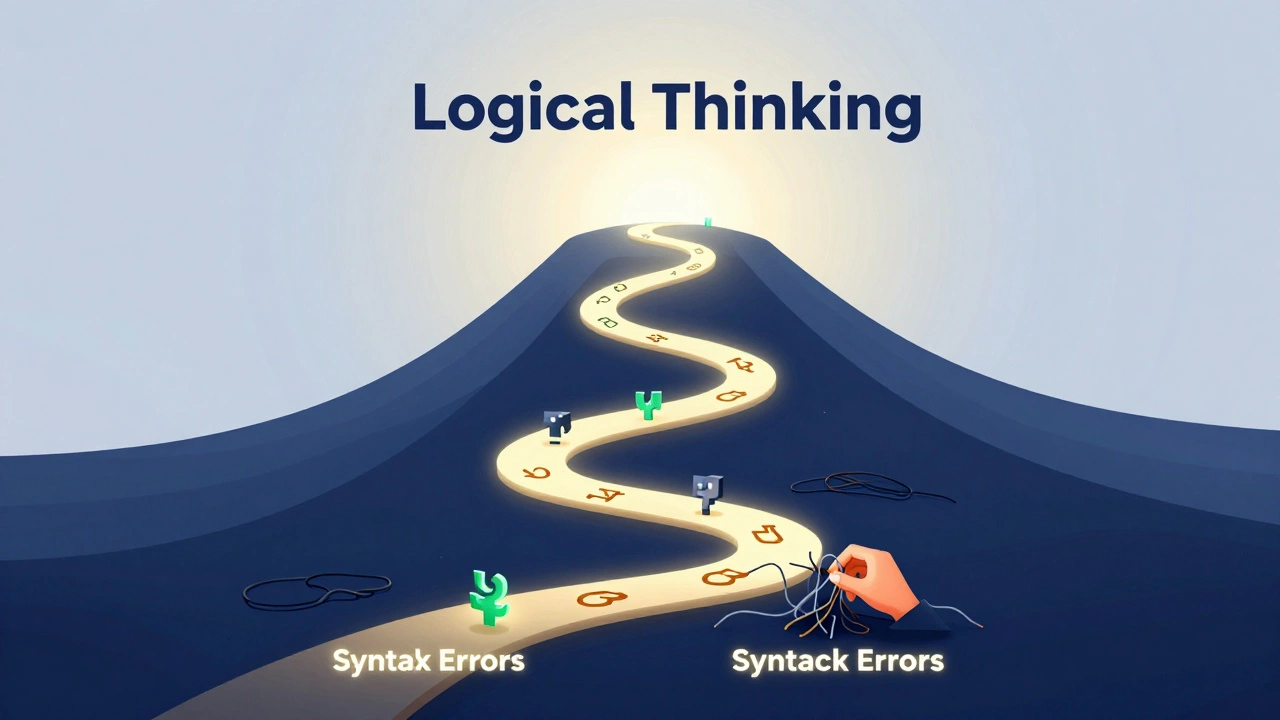
- Syntax Errors are typos or structural mistakes in the code that prevent it from running. Missing a semicolon, closing a bracket too early, or misspelling a variable name can crash your entire program. For a beginner, finding these errors feels like looking for a needle in a haystack.
- Logical Errors are bugs where the code runs but produces the wrong result. This is harder to debug because there are no error messages. The computer does exactly what you told it to do, but not what you wanted it to do. This requires developing "computational thinking"-the ability to break down problems into small, manageable steps.
- Imposter Syndrome is a psychological pattern where individuals doubt their accomplishments and have a persistent internalized fear of being exposed as a "fraud". In coding, this manifests when you see others solving problems quickly while you’re stuck on a simple loop. Remember: everyone sees the highlight reel, not the behind-the-scenes struggle.
In 2026, tools have gotten significantly better at helping with the first two issues. Modern Integrated Development Environments (IDEs) like Visual Studio Code come with AI assistants that can spot syntax errors instantly and even suggest fixes. However, they cannot replace the need for you to understand the logic. Relying too heavily on AI without understanding the fundamentals will leave you stranded when the AI gives a wrong suggestion.
Choosing Your First Language Matters
One of the biggest decisions a beginner makes is which programming language to start with. Picking the wrong one can make the learning curve feel unnecessarily steep. Here is a breakdown of popular choices for beginners:
| Language | Best For | Difficulty Level | Key Advantage |
|---|---|---|---|
| Python | Data Science, AI, Backend Web Dev | Low | Clean, readable syntax that resembles English |
| JavaScript | Web Development, Interactive UIs | Medium | Runs directly in the browser; immediate visual feedback |
| HTML/CSS | Website Structure and Design | Very Low | Not strictly "programming," but essential for web devs |
| Java | Android Apps, Enterprise Software | High | Strict structure teaches strong fundamentals |
If you want to see results quickly, start with HTML and CSS. They aren’t programming languages in the traditional sense-they don’t have logic or variables-but they teach you how the web works. Once you’re comfortable, move to JavaScript. If you’re interested in data or artificial intelligence, Python is the gold standard for beginners due to its simplicity. Avoid starting with C++ or Java unless you have a specific academic requirement. Their strict syntax can discourage new learners before they even grasp the fun parts of coding.
The Role of Coding Classes vs. Self-Study
You might be wondering: "Do I need a teacher?" The internet is full of free tutorials, YouTube videos, and documentation. So why do people still pay for coding classes are structured educational programs designed to teach programming skills through guided instruction?
Self-study is fantastic if you are highly disciplined and know exactly what you need to learn. But most beginners don’t. They get stuck in "tutorial hell"-watching video after video without actually building anything. Coding classes provide structure. They give you a curriculum that moves logically from basics to advanced topics. More importantly, they provide community.
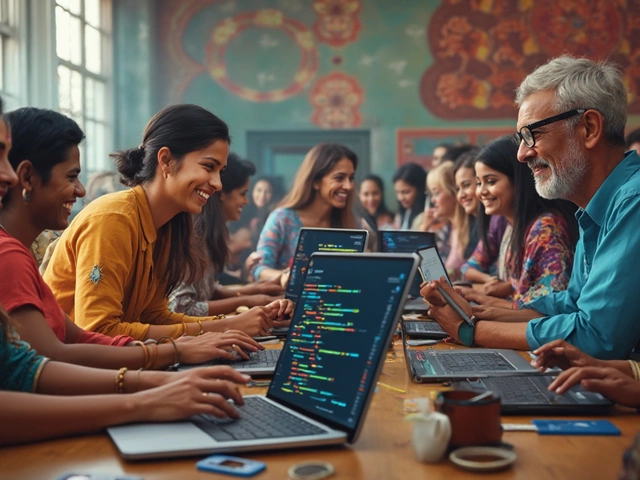
Learning to code can be isolating. When you’re stuck on a bug for four hours, having a mentor or a peer group to ask for help is invaluable. In a classroom setting, whether online or offline, you normalize the struggle. You realize that the person sitting next to you is also confused about loops. That shared experience reduces anxiety and keeps you motivated.
Practical Tips to Make Coding Easier
Here are five actionable strategies to lower the difficulty barrier and accelerate your learning:
- Build Projects Early: Don’t wait until you “know enough” to start building. Build a simple calculator, a to-do list, or a personal homepage. Applying knowledge cements it in your memory. Theory without practice is forgotten within days.
- Embrace Debugging: Instead of fearing errors, celebrate them. Each error message is a clue. Learn to read stack traces. Use console logs to print out values at different stages of your code. Debugging is 50% of a developer’s job, so getting good at it early pays off.
- Code Every Day: Consistency beats intensity. Thirty minutes of coding daily is far more effective than a six-hour binge once a week. Your brain needs regular exposure to reinforce neural connections.
- Read Other People’s Code: Open-source platforms like GitHub allow you to see how experienced developers solve problems. You’ll notice patterns and best practices that tutorials never mention.
- Teach What You Learn: Explain a concept to a friend, write a blog post, or record a short video. If you can’t explain it simply, you don’t understand it well enough. Teaching forces clarity.

Avoiding Common Pitfalls
Even with the best intentions, beginners often fall into traps that slow down progress. Watch out for these:
- Comparing Your Chapter 1 to Someone Else’s Chapter 20: Social media is full of successful developers sharing their wins. Remember, they started somewhere. Focus on your own journey.
- Copy-Pasting Without Understanding: It’s tempting to copy code from Stack Overflow to fix a bug. Do it if you must, but always read the code line by line to understand why it works. Otherwise, you’re just memorizing solutions, not learning problem-solving.
- Ignoring Fundamentals: Jumping straight into complex frameworks like React or Angular before understanding basic JavaScript will lead to confusion. Master the basics first. Frameworks change; fundamentals stay the same.
The Future of Coding for Beginners
In 2026, the landscape of coding education is evolving. AI-powered tutors can now provide personalized feedback in real-time. No-code and low-code platforms allow you to build applications without writing traditional code. Does this mean learning to code is obsolete? Absolutely not.
Understanding code gives you control. No-code tools are powerful, but they have limits. When something breaks or you need a custom feature, you need to know how to dive under the hood. Moreover, coding teaches you how to think logically and solve problems systematically. These skills are transferable to any career, not just software development.
Whether you want to switch careers, automate tedious tasks at work, or simply build a hobby project, coding is a superpower. It’s hard at first, yes. But like riding a bike, once you get the balance, you never forget. The frustration you feel today is the price of admission to a world of creative possibility. Keep going.
How long does it take to learn coding as a beginner?
It depends on your goals. To learn the basics of a language like Python, you might spend 2-4 weeks practicing a few hours a day. To become job-ready as a junior developer, it typically takes 6-12 months of consistent study and project building. Mastery is a lifelong process, but functional proficiency is achievable within a year.
Do I need a math degree to learn coding?
No. While advanced fields like machine learning or game engine development require strong mathematics, most web development, mobile app creation, and automation tasks rely on basic arithmetic and logical reasoning. You don’t need calculus to build a website.
Is it better to learn coding online or in-person?
Both have merits. Online courses offer flexibility and lower costs. In-person classes provide immediate feedback and networking opportunities. Many beginners find success with hybrid models: structured online courses combined with local meetups or online communities for support.
What is the easiest programming language for absolute beginners?
Python is widely considered the easiest due to its clean, readable syntax that mimics English. JavaScript is also a great choice if you are interested in web development because you can see results immediately in your browser without installing extra software.
Can I learn to code if I am over 30?
Absolutely. Age is not a barrier to learning to code. In fact, older learners often bring valuable domain expertise and life experience to their coding projects. Many successful developers switched careers in their 30s, 40s, and even later. The key is patience and consistent practice.